What conditioning actually does
Worth establishing before assessing any product. Leather is collagen fiber, and it stays flexible because of the oils and fats worked into it during tanning. Those leave over time — through handling, heat, flexing and simple age. As they go, the fibers stop sliding past one another, the leather stiffens, and eventually it cracks along the lines where it folds.
A conditioner replaces those oils. That is the entire job. It is not a cleaner, it is not a waterproofer, and it does not repair damage that has already happened — conservation guidance is consistent that cracked fibers do not knit back together, whatever a product claims. What it does is keep leather in the state where cracking never starts.
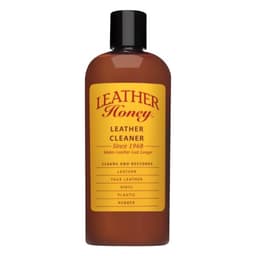
What Leather Honey does well
It absorbs. The most common failure mode in this category is a product that sits on the surface, stays tacky and collects grit. Applied thinly, this soaks in over a few hours and leaves the leather feeling like leather rather than like a treated surface.
A little goes a very long way.This is genuinely the headline. The correct dose for a handbag is a smear on a cloth — less than you would put on a slice of toast. People routinely use ten times that, then complain about tackiness, which is a dosing problem rather than a product problem.
It works across grades. Full-grain absorbs it readily; a finished mid-grade hide takes less and needs less. It is not a specialist product, which is exactly what you want in the one bottle you own.
Shelf life.It does not go rancid the way a household oil does, which is the entire reason not to use olive oil on a bag — a mistake we cover in our scratch removal guide.
The darkening, stated plainly
This is the reason a review exists rather than just a recommendation. Leather Honey is oil-rich, and oil-rich conditioners darken most hides to some degree. On mid-brown or dark leather that reads as richness and depth, and it is part of why people like the product. On cream, pale tan, white or pastel leather it is a visible, largely irreversible change.
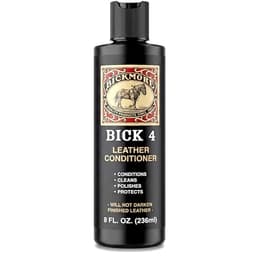
There is no technique that avoids this. Using less reduces it; it does not eliminate it. If your bag is pale and you want it to stay pale, the correct answer is a lighter cream conditioner formulated not to darken — Bick 4 is the specific alternative, and it is on this site precisely for this reason. We put the two side by side in our Leather Honey vs Bick 4 comparison.
The corollary: spot-test on the base or an inside corner and wait several hours before judging. Conditioner darkens temporarily as it absorbs, so an area that looks alarming at ten minutes often evens out by morning. Judging too early is how people conclude they have ruined a bag they have not.
What it is not for
Suede and nubuck. Never. Oils flatten nap permanently, and this is the most common way a good suede bag is destroyed by someone trying to look after it. Our suede care roundup covers what those materials actually want.
Patent and heavily coated leather. There is a finish in the way, so the conditioner cannot penetrate. It will produce a temporary shine and nothing else.
Cleaning.This is not a cleaner, and conditioning a dirty bag drives the dirt into the grain. Clean first, let it dry fully, then condition — the routine is in our cleaning guide.
Waterproofing.It offers some incidental repellency, and it is not what it is for. A dedicated protector spray does that job properly and without the darkening — see our protector roundup.
How to use it properly
Clean the bag and let it dry completely. Spot-test on a hidden area and wait several hours. Then put a small amount on a soft cloth — genuinely small — and work it in with light circular passes across a whole panel rather than a patch, feathering out so there is no edge.
Leave it overnight. Wipe off anything that has not absorbed with a clean dry cloth. That last step is what separates a conditioned bag from a tacky one, and it is the step most people skip.
Frequency: once or twice a year for a bag in normal use, more in a dry climate or if the bag lives outdoors. Over-conditioning is far more common than under-conditioning and causes its own problems, covered in our troubleshooting guide.
Who should buy it
Buy it if your bags are mid-brown, dark brown, tan or black and you want one bottle that handles all of them for years. Buy it if you own full-grain, which absorbs it readily and benefits most. Buy it as a gift for anyone who owns a leather bag — it is the least risky leather gift there is, which is why it leads our gift guide.
Who should not
Skip it if your bag is cream, pale tan, white or pastel — buy Bick 4. Skip it if the bag is suede, nubuck, patent or heavily coated. And skip it if what you actually need is a cleaner, which is a different product doing a different job.
If you are weighing it against one specific rival
Two comparisons do the work properly rather than in a paragraph. Leather Honey versus Bick 4 is the darkening question settled, and Bick 4 wins it on the strength of a claim Bickmore actually publishes. Leather Honey versus Lexol is the more interesting one, because it is not really about formula quality — Leather Honey is built around one deep application that the maker says lasts six months, while Lexol’s own directions ask for light repeated coats. Which of those suits you depends on how often you will honestly open the bottle.