What heat actually does
Tanned hide is a fibre network held apart and lubricated by oils, with a controlled amount of bound moisture in it. Raise the temperature and both the moisture and the lighter oil fractions migrate out. Do that once and the leather recovers. Do it every working day for a summer and the fibres spend more and more time pressed against each other with less and less between them, and eventually they set that way.
That is why the progression is so consistent: first the bag feels a bit dry, then it feels tight and resists bending, then creases that used to relax stay put, and finally a crease becomes a crack. Everything up to the last stage is recoverable by putting the oils back. The last stage is structural and the most that can be done is cosmetic.
This is the same mechanism as drying a soaked bag with a hairdryer, just delivered slowly instead of all at once — our got-wet page covers the fast version. Conservation guidance for leather objects is built around exactly this: stable, moderate temperature and humidity rather than cycling, because it is the cycling that does the damage.
What UV actually does
Fading is a chemical change in the dye, not a layer of colour sitting on top that has worn away. Ultraviolet photons break the bonds in dye molecules, and once broken they do not reassemble. This is why the two most common questions about sun damage both have disappointing answers: no, conditioning will not bring the colour back, and no, it will not even out on its own.
The uneven part is the real problem. Sun damage is directional, so you get a bag that is two colours: whatever faced the window and whatever did not. A strap lying across the front leaves a crisp pale line. That is much more visible than overall fading would be, and it is the thing that makes people retire a bag that is otherwise fine.
Vegetable-tanned and aniline-dyed leathers fade faster than pigmented ones, because there is less sitting over the dye. That is the same trade as everywhere else on this site: the finishes that patina beautifully are the finishes with less protection on them. Our patina guide and our tannage guide explain which surfaces behave which way. It is worth distinguishing patina from sun fade, because they get confused: patina is darkening and deepening from hand oils and handling, and sun fade is lightening and flattening from UV. One is the bag improving and the other is the bag wearing out, and they look nothing alike once you know.
What to do, by symptom
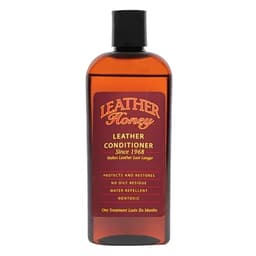
Dry, tight, stiffer than it was: condition, repeatedly.Not one heavy application — two or three moderate ones over a fortnight, complete panels at a time, letting each fully absorb before the next. An oil-rich conditioner is the right choice here rather than a light surface product, which is why Leather Honey is our pick for this specific case. Expect darkening and do the whole bag so it is even. Our conditioning guide has the routine, and our conditioner roundup compares the field on darkening risk.
Faded, but still supple: condition with the non-darkening option, then decide about colour. On a bag that has lost colour, a conditioner that darkens will make the faded and unfaded areas more different rather than less. Bickmore publishes a non-darkening claim for Bick 4 and states it is wax-free, which makes it the safer bottle on a sun-bleached bag. Our Bick 4 versus Lexol page goes through which maker publishes what.
Faded badly or unevenly: a recolouring balm is the only real fix. A pigmented balm adds colour back to the surface rather than feeding the hide, and it is the honest answer for a bag with a pale stripe across it. Two things to be clear about: it is a surface treatment, so it will mute the character of an open-grain hide, and matching a faded bag is a blending job rather than a precise one. Spot-test somewhere hidden, build up thin coats, and read our repair-kit page for how the recolouring products compare and where the limits are.
Cracked at the fold points: stop expecting a cure. The fibre structure has failed and no product rebuilds it. A flexible filler and a recolouring balm will make it much less visible and will stop the crack propagating as fast, and that is the realistic goal. Our troubleshooting page names the point at which a restorer is the better call.
A coated synthetic that has gone sticky or lifted: it is finished. Heat is what accelerates the breakdown of polyurethane coatings and synthetic linings, and the symptoms are a tacky surface and then flaking. There is no treatment, and our material comparison treats this as the clearest practical argument for real hide. Our lining guide covers the same failure on the inside of an otherwise good leather bag.
Preventing all of it
Stop leaving it in the car. This is ninety per cent of the page. A bag in a car is in heat cycling, often in direct sun, for hours at a time, repeatedly. If it has to travel in a car, put it in the boot or on the floor behind a seat rather than on a seat in the sun, and take it inside at the end of the day.
Do not store it in a window, a conservatory or an attic. A bag on display in daylight will fade on the side that faces out, and the fade will be crisp-edged and obvious. An attic adds heat cycling to it. Our storage guide has the full routine: a cool interior cupboard, a cotton dust bag rather than plastic, stuffed to hold its shape.
Rotate which side faces out. If a bag does live somewhere with daylight, turning it occasionally spreads any fading evenly, and even fading is vastly less noticeable than a line.
Keep it conditioned before the dry season rather than after. A well-fed hide has more to lose before it starts to tighten. Twice a year is the usual advice and the spring application is the one that earns its keep.
Be realistic about what a spray does. Water and stain repellents protect against liquid, not against UV or heat. There is no consumer product that meaningfully blocks ultraviolet light on a bag, and we are not going to recommend one as if there were. Our protector-spray roundup is clear about what that category is for. Shade is the only real UV protection, and it is free.