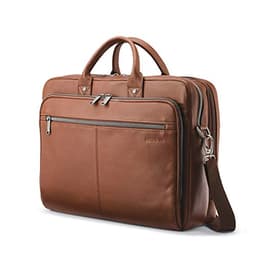
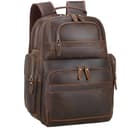
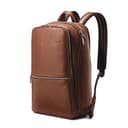
Weight: nylon, by a wide margin
This is the one that changes how your day feels, and it is not close. The empty weights published across every bag we track run from 0.91 pounds for a small sling to 3.35 pounds for a large full-grain tote, with most real-leather work bags landing between 1.8 and 2.8 pounds. Those are the figures before a laptop, a charger and a water bottle go in. A nylon bag of the same capacity is typically well under a pound, because the material is thin and the structure comes from the weave rather than from thickness.
A pound and a half of difference sounds trivial written down and is not trivial carried on one shoulder for ten hours. If you walk a long commute, cycle, or move between buildings all day, weight is probably the single most important property of a bag, and leather loses it outright. Our bag weight page publishes every figure we hold and records which listings publish nothing, which is a surprising number of them.
Weather: nylon, and the gap is bigger than people admit
Nylon is a plastic fibre. Water does not soak into it, and most bag nylon has a coating on top of that. It dries in minutes, it does not stain from rain, it does not grow mould if it gets put away damp, and nothing about a downpour requires a decision from you.
Leather needs managing. It can be protected and it can take a lot more rain than people fear, but the honest version is a list of obligations: a protector spray is a real step rather than an optional one, a soaking needs a careful slow dry or the hide stiffens permanently, and a damp bag put in a cupboard grows mould. We have whole pages on each of those — our waterproofing guide, our got-wet page and our mould guide — and the existence of those pages is itself the argument. A nylon bag needs none of them.
Price and features: nylon again
For the price of a mid-range real-leather briefcase you can buy a nylon commuter bag with a trolley sleeve, a water-bottle pocket, a dedicated padded laptop compartment, a quick-access top pocket and a luggage pass-through. Look at the leather market for that feature list and it mostly does not exist — a handful of totes in our registry state a trolley strap and almost none state a bottle pocket. Hide is expensive, and cutting and stitching complex organisation into it is expensive, so leather bags tend to be simple and nylon bags tend to be clever.
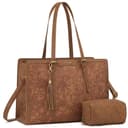
This is also where the coated synthetics come in, and why one is on the list above. A PU bag like the LOVEVOOK laptop tote — padded 15.6-inch compartment, a layout built for commuting, a fraction of the price — is not really competing with leather on material. It is competing on how well it does the job, and at the bottom of the market it often wins. We say so on our leather versus vegan leather page rather than pretending otherwise. The difference between coated synthetic and nylon is worth knowing too: nylon is a woven fabric that wears thin, while PU is a plastic film over a backing that eventually peels. Nylon ages better than PU.
Formality: leather, and it is the whole case
A bag is a worn object, and worn objects are read. Nylon reads as equipment: technical, practical, sporty, and in some rooms slightly out of place. Leather reads as clothing: it belongs with a coat and shoes rather than with a bicycle. That is not snobbery, it is just how the signal works, and it is the reason a luggage company famous for nylon still keeps a leather line on the shelf.
If your bag goes to client meetings, court, interviews or anywhere the first thirty seconds matter, this single factor can outweigh the three nylon wins above. Our briefcases for lawyers page is the extreme version of that argument, and our men’s briefcase roundup sorts bags by formality register explicitly, which is the useful way to shop once you have decided leather is what you want.
Ageing and repair: leather, decisively
Nylon has one trajectory. It arrives at its best and gets worse: the face fuzzes, the coating scuffs white, the webbing frays, and a worn nylon bag looks worn rather than aged. Nothing restores it. There is no conditioning a woven synthetic and no refinishing a scuffed coating.
Full-grain leather does the opposite, and it is the only material in common bag use that does. The surface darkens and deepens with hand oils and light, scratches burnish in rather than standing out, and the bag at five years is more attractive than the bag at one. Our patina guide explains which grades and finishes can do that at all — it is a narrower set than marketing suggests, and a sealed top-grain or a coated finish will not.
Repairability compounds it. A scuffed leather panel can be cleaned, fed and recoloured; a cut can be filled; a worn edge can be re-coated; stitching can be redone; a sewn lining can be replaced. Our repair-kit page matches products to each of those. The equivalent list for a nylon bag is empty beyond replacing a buckle. That is what people are actually buying when they buy leather: not a longer life, but a life that is worth extending.
How to decide, in four questions
- Does the bag ever need to be formal? If no, buy nylon and spend the difference on something else. This question settles most cases on its own.
- How far do you carry it, and on which shoulder?A long walk with a heavy laptop is an argument for nylon, or at minimum for two straps — our briefcase versus backpack page covers that trade-off.
- Do you want to look after it? Conditioning twice a year and a protector spray is not much, but it is not nothing. If the honest answer is that you will never do it, leather will not reward you and nylon will not punish you.
- Do you want to still own it in ten years? This is the only question where leather is not just competitive but unanswerable. Our worth-it guide works the cost-per-year arithmetic, and our lifespan guide is honest about what actually fails first.
And if you want leather but the weight worries you, the answer is grade and shape rather than giving up. A goat-hide or top-grain bag is lighter than full-grain at the same size — our goat versus cowhide guide has the published figures — and two straps move the load off one shoulder. Our minimalist backpack page is where those two ideas meet.