Where it shows up, in order
Sweat damage is always local, and it is always where the bag touches you. If you know the shape, you know where to look.
- A backpack’s back panel and shoulder straps. The worst case by a long way, because the panel is pressed flat against you with no air behind it for the length of a commute. This is the one case where we would change the bag rather than only the routine.
- A crossbody strap and the panel that rests on your hip. A narrow strap crossing your chest and neck collects a surprising amount, and it is the part of the bag closest to your eye line when it starts to look tired.
- A tote’s handles and the back face. Hands rather than body here, so it is sebum and hand cream as much as sweat, and it ends up as the sticky, dark handle our strap and handle page deals with.
- Anywhere a bag sits against a car seat in summer. Not your sweat, but the same cycle of warmth and moisture in one spot.
The routine that keeps it out of trouble
Four steps, in this order, and the first one is the one that actually matters.
1. Wipe the contact panel the same day.A cloth barely damp with plain water, wiped over the back panel or strap on a hot day, removes the salt while it is still dissolved and before it crystallises. Thirty seconds, and it prevents the problem rather than treating it. Let the bag dry at room temperature, out of the sun and away from any heat source — our heat damage page explains why forced drying is the one mistake that does not come back.
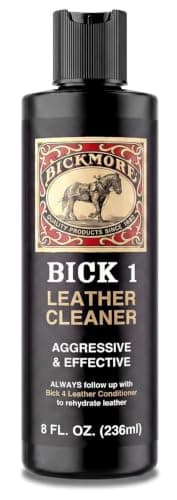
2. Clean properly when a mark has already formed. Use a leather cleaner on a damp cloth and work the whole panel, not the mark. This is the key technique: spot-treating a tide line pushes the salt outwards and gives you a second ring further out. Change the cloth as it loads up, and expect to go round twice on a panel that has had a season of this.
3. Condition afterwards, every time.Cleaning lifts the leather’s own oils along with the salt, and the panel you have just cleaned is the panel that was already drying out faster than the rest of the bag. A light conditioner is the right choice; on a dark bag, one with a published non-darkening claim avoids making the contact patch stand out even more. Our conditioning guide has the method and the darkening warnings.
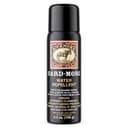
4. Put a barrier on before the season, not after.A water and stain repellent on the back panel and strap gives the salt something to sit on instead of soaking in. It is not waterproofing — nothing is — and it needs a spot-test on the base first, because any spray can change the look of an open finish. Our protector spray roundup compares the field.
Does a leather bag make you sweat more?
Against your back, yes — and this is a comfort question rather than a damage question. Leather is a dense, largely non-breathable panel, so a leather backpack worn flat against you traps heat in a way a mesh-and-foam technical pack does not. Nothing about the material fixes that; the only thing that helps is construction, specifically a padded back with mesh and channels that hold the leather off your shirt and let some air move.
Here is the honest state of our own registry: of the leather backpacks we list, onepublishes a breathable mesh back panel in its listing, and it is the Yevabo above. Everything else is a leather panel against your back. That is not us being hard on the category — it is what the listings say, and where a listing does not state a feature our tables record it as not published rather than assuming it. If you sweat heavily and carry on your back daily, that single spec is worth more to you than a grade upgrade, and a canvas or nylon pack would be better still, as our leather versus nylon comparison and leather versus canvas page both say plainly.
The lower-tech answer is to change the shape. A tote or a briefcase hangs away from your torso and never touches your back at all; a crossbody touches a narrow strip rather than a whole panel. If your commute is hot and long, our page on carrying weight comfortably weighs that trade-off against the load on your shoulder, because the two pull in opposite directions: the shape that is kindest to your shoulder is the shape that sits against your back.
What sweat will not do
Two reassurances, because this is a topic people over-worry. Sweat will not dissolve or rot a tanned hide: leather is itself naturally acidic, and the mild acidity of sweat is not what causes the damage — the salt and the repeated wetting are. And a darker contact panel is not a fault. A strap and a back panel darkening with use is patina, and on the right leather it is the best-looking part of the bag; our patina guide makes that case.
The things to act on are specific: a white or pale crust, a panel that has gone stiff compared with the rest of the bag, and a surface that feels tacky rather than simply dark. Those three are salt and build-up doing their work, and all three respond to the routine above. Our troubleshooting page covers the marks that are not sweat, and the care starter kit is the shortest set of bottles that handles all of it.