What the Italian reputation is actually built on
Italy’s standing in leather is not marketing invented for handbag copy. It rests on a concentration of tanneries in one region, working with vegetable tannage, over a long enough period to build specific skills. The consortium’s own account of itself is a useful description of that: a group of Tuscan tanners who organized in 1994 to protect a niche of high-quality product, now 18 tanneries in one district, producing vegetable-tanned leather by traditional methods that the consortium describes as taking time, patience and a combination of technology and experience.
The important word in all of that is vegetable-tanned. That is a process claim, and it is the one that changes how a bag behaves. Vegetable tannage uses plant tannins and produces a hide that darkens and deepens with light and handling — the mechanism behind a patina. Chrome tannage is faster, cheaper and far more common worldwide, and produces a more stable, more uniform, more water-resistant hide that largely stays the color it shipped in. Both are made in Italy, in volume. Our vegetable versus chrome tanning guide goes through the difference, and our patina guide explains which finishes can develop one at all.
So a bag described as Italian leather may be vegetable-tanned Tuscan hide from a consortium tannery, or chrome-tanned hide from an Italian plant, or — and this is the possibility the phrase conceals — hide tanned somewhere else and finished or assembled in Italy. None of those is dishonest on its face. They are just very different materials sharing one phrase.
What the label does not tell you
It is not a grade
This is the single most useful thing to internalize. Grade describes which layer of the hide you are getting; origin describes where it was processed. Italian corrected-grain leather exists and is perfectly ordinary material. All four picks on this page happen to state full-grain as well as Italian, which is why they are here — the grade claim is doing the work, and the origin claim is supporting detail. Our full-grain versus top-grain guide is the one to read if that ladder is unfamiliar, and our guide to “genuine leather” covers the phrase sellers reach for when they would rather not name a grade.
It is not what the labeling rules are about
The FTC’s leather guides govern whether a material may be called leather at all and require imitation material that looks like leather to be disclosed as such. They are not an origin-certification scheme for handbags. So “Italian” on a marketplace listing is a seller’s description, and the consortium trademark — a private quality mark with a published membership — is the thing with a verifiable list behind it.
And we cannot verify it from a listing
We should be straightforward about the limits of our own research. We read marketplace listings and record what they state, on a dated visit. None of the four bags on this page publishes a tannery, a tannage or a consortium trademark, so what our spec tables record is “Italian full-grain leather” — the seller’s claim, attributed to the seller. We have not audited a supply chain and we are not going to imply that we have. If verified Tuscan vegetable-tanned hide is a requirement for you, buy from a maker that names its tannery, and check that name against the consortium’s own published list of members.
How to read the claim on a bag you are considering
- Find the grade first. If there is no grade next to the word Italian, treat the listing as an unnamed grade and price it accordingly.
- Look for the tannage.“Vegetable-tanned” is the claim that connects to the Tuscan reputation. Its absence does not mean chrome, but its presence is meaningful.
- Check whether the title and bullets agree. Our tables record the lower claim whenever they conflict, and that habit will serve you well on any listing.
- Ask what “Italian” is attached to. Italian leather, Italian design and made in Italy are three different statements, and only the first is about the hide.
- Weigh it against the published specs. A listing that publishes dimensions, a weight and a laptop fit has measured the bag. Two of the four picks here publish none of those, which we record as not published rather than estimating.
Which of these four to buy
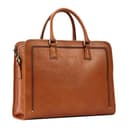
For a real briefcase, the Banuce women’s case.Italian full-grain, genuinely structured, and sized for a 15.6-inch laptop rather than hoping one fits. It is the most expensive women’s work bag we list and it is heavy before you load it, which is what structure costs. The rest of that category is on our women’s briefcase roundup.
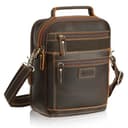
For the least money, the Polare sling. Italian full-grain in a business-leaning shape that survives a smart-casual office, rather than an outdoors chest rig. Capacity is leaner than the shape suggests and the dark finish shows dust. Our full-grain crossbody page compares it with the alternatives.
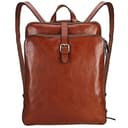
For one bag that covers two shapes, the Banuce convertible. It switches between a backpack and a shoulder bag, which is the feature that lets it handle a commute and an evening. Its listing states no laptop size at all, so do not buy it as a work pack, and it publishes neither dimensions nor weight. Our women’s backpack roundup has the bags built around machines.
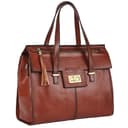
If you want the bag to be the outfit, the Banuce purse. Italian full-grain with fringed detailing and sturdy hardware — the most style-driven and the priciest of the four. The fringe is a specific look and it is not a laptop bag by any reading.
Is Italian leather worth paying more for?
Sometimes, and for a narrower reason than the phrase implies. If the extra money buys vegetable-tanned full-grain hide from a tannery that will name itself, you are paying for a material that behaves differently in your hands over ten years, and that is a real purchase. If it buys the word Italian next to an unnamed grade, you are paying for the word.
The practical way to spend the same budget well is to rank the claims by how checkable they are: grade first, tannage second, origin third, brand story last. Our leather bag buying guide works through the whole decision in that order, and our guide to why leather bags cost what they do breaks down where the money actually goes in a finished bag.