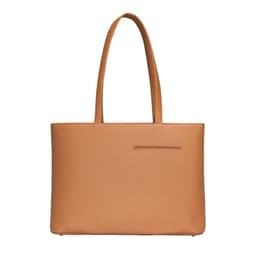
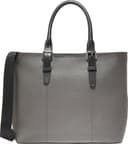
How the finish is made, and why it behaves the way it does
The hide goes through a plate or roller carrying the cross-hatch pattern, under enough heat and pressure to deform the surface permanently. Then it is finished — pigmented and sealed, usually with a wax or polymer top coat. Those two steps produce four effects, and all four follow directly from the process rather than from marketing:
- It resists and hides scratches. A cross-hatched surface has no flat area large enough to show a clean scratch line, and the coating resists the scratch in the first place. This is the property people buy it for.
- It holds structure. Pressing and coating stiffen the panel, which is why saffiano bags keep a crisp, boxy shape when empty instead of slouching.
- It is water-resistant and wipeable.The sealed surface does not absorb, so a spill sits on top long enough to be wiped off. It is not waterproof — nothing leather is, and the stitching and edges are unprotected either way.
- It is uniform. The pattern and pigment hide the natural variation in the hide, so colour is consistent panel to panel and bag to bag. Whether that is a feature or a loss is a matter of taste.
What it costs you
No patina, ever. Patina is the result of oils, light and handling reaching the fibre and changing it. A sealed surface stops all three at the door, so the bag does not darken, deepen or develop the character that everything else on this site is about. Our patina guide explains which surfaces can do it at all.
Conditioner mostly cannot get in.This is the practical consequence people get wrong. Oiling a saffiano bag does very little — the product sits on the coating and has to be wiped off. The care routine is cleaning and protection rather than feeding, which our conditioning guide sets out by leather type.
Damage is hard to repair.You cannot re-emboss a pattern at home. A scuff that goes through the coating leaves a pale mark in a textured surface, and recolouring it convincingly is a specialist job rather than a balm job. Over years the coating can also crack at the flex points — the corners and the fold where a handle meets the body — and cracked coating has no home fix. Our corner and edge wear page covers what can be done at the places this finish fails first.
It is heavier than it looks, and stiffer than some people like. A structured bag has more material and more backing than a soft one of the same volume, and a stiff panel does not give when you overfill it.
Saffiano vs pebbled vs smooth
These three words cover most of what you will see in a listing, and they are genuinely different things.
- Saffiano— a pressed cross-hatch, almost always with a sealing coat. Most resistant, most uniform, least able to age.
- Pebbled— a round-grain texture, either natural to the hide or embossed, and usually finished more lightly than saffiano. It still hides marks well but can retain some ability to darken with use. Our pebbled versus smooth guide goes into the detail.
- Smooth— the natural grain left visible. The most beautiful and the most honest, and the one that shows every mark. Full-grain smooth leather is the opposite end of the spectrum from saffiano; our full-grain explainer covers what you are getting there.
Is saffiano real leather?
It can be, and it very often is not — and the finish name will never tell you. Three checks, in order:
- Read the material line, not the title.“Saffiano” in a title alongside “PU”, “vegan leather” or “man-made” in the specification means plastic with a pressed pattern.
- Look for a stated grade.Calfskin, full-grain or top-grain is a commitment; “saffiano leather” on its own is not a grade, and our genuine-leather explainer covers what that phrase legally allows.
- Check the edges and the back of a flap. A coated synthetic usually has a fabric backing visible at a cut edge, where real hide shows a fibrous cross-section. Our guide to spotting fake leather has the full set of tells, several of which work from a listing photograph.
None of this means a coated bag is a bad buy. A well-made PU bag with a smart layout can be the right purchase, as our leather versus vegan leather page argues — as long as you know what you are buying and are not paying calfskin money for it.
Who should buy it
Buy a saffiano-finished bag if your working life is hard on bags and you want one that looks composed anyway: a commute, an office with a dress code, client meetings, a bag that gets set down on surfaces and carried in a car. It is also the most sensible leather finish for anything that meets cleaning products routinely, which is why it comes up in our totes for nurses page.
Do not buy it if the reason you want a leather bag is the way leather gets better. That bag exists, it is cheaper than you think, and it is in our full-grain tote roundup and full-grain crossbody picks. The two are different purchases and they are both valid; the mistake is buying one while expecting the other.