The three finishes that produce a real distressed look
1. Waxed or oiled pull-up leather
Hide finished with a wax or oil that sits within the fibers rather than on top of them. When you bend or press the leather, the wax migrates away from the pressure point and the color lightens there; relax it, or warm and rub it, and the color comes back. That is the whole mechanism, and it is why a waxed bag records where it has been folded and handled.
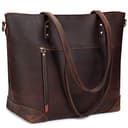
The befen vintage waxed tote is the example here. Its listing calls it waxed cowhide and states that creasing and marking are expected, which is exactly right: the marks are the finish, not damage to it. The honest con is that they are permanent in the sense that the bag will never look new again — if you want a bag that stays pristine, this is the wrong finish and we say so on the product card.
2. Crazy horse leather
A specific, widely used version of the same idea: hide finished with oil and wax so that it lightens where it is bent and scuffed. It is the finish behind a very large share of the bags sold as “vintage leather” on marketplaces, including the S-ZONE top-zip work tote on this page. The practical thing to know is that crazy horse scuffs readily and buffs out readily — a mark you dislike will often rub away with a thumb and a little warmth, which is not true of a printed finish.
3. Vegetable-tanned hide left to age
Not a distressing process at all, but it reaches a similar place. Vegetable tannage produces a hide that darkens and deepens with light and hand oils, so the bag arrives relatively pale and earns its color. The HULSH veg-tan rucksack in our registry is explicit that it will patina rather than stay the color it shipped in. Our vegetable versus chrome tanning guide explains the chemistry in plain English, and our patina guide covers which finishes can develop one at all.
The one to avoid: an antiquing effect on corrected grain
This is where the word distressed earns its bad reputation. Take a hide whose surface has been sanded off and sealed, then spray or print a two-tone, worn-looking pattern onto the sealed layer. In a photograph it is extremely convincing. In use it behaves like paint, because that is close to what it is: it does not lighten under pressure, it cannot be buffed back, and when the coating eventually wears through at a corner or a handle root, what shows underneath is a different color entirely.
Three tells, in order of how much they are worth:
- No mechanism is named. A listing that says vintage, retro, distressed or antiqued without once saying wax, oil, pull-up, crazy horse or vegetable-tanned is describing a look, not a process.
- The pattern repeats.Real marking follows how the bag is built and used — creases at the fold lines, lightening at the corners and handle roots. A printed effect is distributed evenly across flat panels because it was applied to a flat hide.
- No grade is named. Nearly all sprayed antiquing is applied to corrected grain, because that is the surface that takes it. Where a listing distresses full-grain hide, it almost always says full-grain, because that is the expensive part.
Our guide to spotting fake leather covers the checks that survive a listing photograph, and our guide to “genuine leather” explains the phrase you will see where a grade should be.
Why distressed finishes suit some hides better
A distressed finish needs relief to catch on. That is why buffalo, with its coarser and more irregular grain, carries distressing so convincingly — the KomalC tote on this page is distressed buffalo and the effect reads as the hide rather than as a treatment. On a fine, smooth, corrected cow panel the same finish has nothing to grip and looks applied. Our buffalo versus cowhide guide goes through the grain difference, and our pebbled versus smooth guide covers natural texture against embossed texture.
Who a distressed bag is right for
Buy one if you are hard on bags. This is the real practical argument and it has nothing to do with fashion. A distressed finish absorbs the first year of scuffs instead of displaying them, which means you stop flinching every time the bag touches a doorframe. It is the single most forgiving finish you can choose for a daily carry.
Buy one if you want the bag to be yours.A waxed or veg-tan hide ends up a record of how you have used it — where your hand sits on the handle, where it folds when it is full. No two end up alike.
Do not buy one if you want it to match. Distressed bags vary unit to unit, and what arrives will not be identical to the photograph. The Firu goat tote in our registry warns about exactly this because its color comes from vegetable oil and sun rather than pigment.
Do not buy one for a formal office. If the room expects a structured black case, a distressed brown bag is the wrong register however good the hide is. Our briefcases for formal offices page is the right one for that.
The vintage-finish bags on this site are shortlisted by category too, if you have already decided: our vintage tote roundup, vintage briefcases, vintage backpacks and vintage crossbodies.
Caring for a distressed bag
Resist fixing it. The commonest mistake is treating the lightened creases as damage and attacking them with product. Most of what looks like a scratch on a waxed or crazy-horse hide will even out with a thumb and a little warmth. Our guide to removing scratches starts with the least drastic option for exactly this reason.
Condition thinly and expect darkening.Any conditioner will darken a waxed or veg-tan hide, at least at first, and an uneven application will darken it unevenly. Thin coats, whole panels, and clean the bag first — our conditioning guide has the method and uses less product than most people do.
Be careful with water and heat. Water spots show on unsealed distressed hides and a radiator will drive the wax and oils out unevenly. Our water-protection guide covers repellents and their honest limits, and our symptom guide works back from what the bag is doing to what caused it.