The thirty-second test, in a shop or at home
Take a white cloth or a plain tissue, dampen it very slightly with water, and rub it firmly against the leather for a few seconds. Pick a spot that will touch your clothing in use — the back panel of a crossbody, the underside of a tote where it sits against your hip, the strap.
- Nothing on the cloth: the bag is sealed or lightly dyed and will not mark anything. Most bags land here.
- A faint tint: normal for a new, darkly dyed, open-finish bag. It will stop. Clean the contact surfaces a few times before you carry it against anything pale.
- A clear colour transfer onto a dry cloth: this bag will mark clothes, now and for a while. Clean it properly before using it, and keep it away from light fabrics until the cloth comes away clean.
Do the same test dry as well as damp. Dye that moves onto a dry cloth is a more serious case than dye that needs moisture to move, because rain and a humid day are enough to set it off. If you are buying online and cannot test, the three listing factors above are your proxy, and a dark unfinished bag is the combination to be careful with. Our guide to spotting fake leather covers what else a listing photograph gives away.
Stopping a bag that transfers
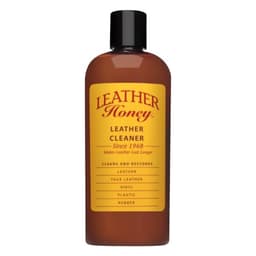
Clean the loose dye off deliberately. This is the actual fix and it is the step people skip in favour of hoping. A leather cleaner on a damp cloth, a panel at a time, lifts surface dye the same way it lifts dirt. The cloth coming away coloured is the mechanism working. Two or three sessions over a week will deal with most bags, and you have removed the dye onto a cloth instead of onto your clothes.
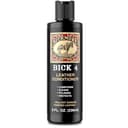
Condition afterwards, and choose the conditioner carefully. Cleaning lifts oils along with the dye, so conditioning is part of the job. On a dark bag, pick a conditioner that will not deepen the colour further — Bickmore publishes a non-darkening claim for Bick 4 and states it is wax-free, which makes it our pick for exactly this case. Our Bick 4 versus Lexol comparison goes through which maker publishes what, and our conditioning guide explains the darkening risk that applies to every conditioner.
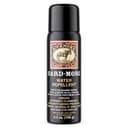
Consider a barrier on the contact surfaces.A water and stain repellent sprayed on the back panel and the strap adds a layer between the dye and your coat. It is a sensible step on a bag you have already identified as a transferrer, and Bickmore’s own Bick 4 directions name Gard-More for the protection step after conditioning. Spot-test it first — any spray can change the look of an unfinished surface. Our protector-spray roundup compares the field.
What does not work:hairspray, vinegar and the various home remedies that circulate for “setting” dye. There is nothing to set — the loose dye is already unbonded, and the only question is what surface it ends up on. Alcohol-based products will take the finish off entirely; our page on washing a leather bag runs through why each of those shortcuts is a bad idea.
If a coat has already been marked
Act quickly, because dye that has been through a wash cycle and a dryer is much harder to shift than dye sitting on a fibre surface. Treat it as a dye stain rather than a dirt stain: do not rub it in, check the garment’s own care label first, and work from the outside of the mark inwards so you do not spread the edge. On a washable fabric a pre-treatment and a cold wash will often take most of it. On wool, silk or anything tailored, a dry cleaner is the sensible first call rather than the second, and telling them it is leather dye gives them a real head start.
Then deal with the bag, because a garment you have rescued once will be marked again next week if nothing changes. That is the whole argument for doing the cleaning step above rather than waiting the problem out.
The direction nobody warns you about
Transfer runs the other way too, and it is the version that damages the bag rather than the clothes. Dark denim is the classic offender: new indigo jeans against a pale leather bag will tint the leather, and on an unfinished pale hide that is close to permanent, because the bag absorbs where a cloth only carries. The same applies to a newly dyed wool coat against a cream bag.
So if you own a pale bag, the precaution runs in reverse: keep it off new dark denim, carry it on the shoulder rather than at the hip when you are wearing something newly dyed, and clean the contact panel early if you see a tint starting. Our troubleshooting page covers dye transfer onto a bag alongside the other marks a bag collects, and our colour guide is worth reading before you buy a pale bag at all — this is one of the several ways a light bag asks more of you than a mid-brown one.
What this means when you are choosing a bag
Do not let it put you off the good stuff. The bags most likely to crock are the open-finish, vegetable-tanned, richly dyed hides — which are also the bags that develop a real patina and look better in five years. The transfer is a few weeks of mild inconvenience in exchange for the finish that every other page on this site is recommending. Our patina guide explains which surfaces can do that at all, and our tannage guide covers why veg-tan behaves this way.
If you genuinely cannot risk it — a white uniform, a job with a dress code, a bag that will be carried against pale clothing every day — then buy a sealed finish and accept the trade. A pigmented or top-coated surface will not transfer, will not patina, and will stay the colour it arrived in. Our top-grain tote roundup makes that case properly: the sealed grade is not a lesser bag, it is a different answer to a different question.