The five criteria
We judged these on the things that change the outcome on a bag, in the order they matter. Everything else — scent, bottle design, how many unrelated surfaces the label lists — is noise.
- Will it change the color? Darkening is the single most common regret in this category, and it is effectively permanent. On a bag you chose partly for its shade, this outranks everything else.
- Does it leave the surface open or sealed? A conditioner that leaves wax or film on top of the grain changes how the leather feels, how it takes a patina, and how much grit it collects.
- How much conditioning does it actually deliver? Dry, stiffening leather needs oil replaced, not a cosmetic refresh. Some formulas feed harder than others.
- What does the maker tell you to keep it away from? A brand that names the leathers its product will ruin is telling you something useful. Both of these do.
- Does it handle the cleaning step, or do you need a second bottle? You clean before you condition, always. Whether that is one purchase or two changes the real cost.
Where they genuinely differ
Darkening: the one-line answer
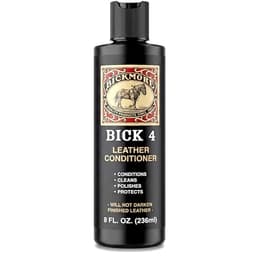
Bickmore states it directly on its own product page: “Unlike most leather conditioners, Bick 4 Leather Conditioner will NOT darken your leather.” That is the brand speaking about its own formula, and it is the reason Bick 4 exists as a separate product from the rest of the Bickmore line.
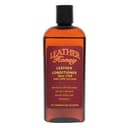
Leather Honey makes no such claim, and its care guide does not address darkening at all — what it says instead is to spot-test anything you apply to leather in a discreet area first. That silence is consistent with what oil-rich conditioners do: they deepen most hides somewhat. On a mid-brown or black bag that reads as richness, and it is a large part of why people like the product. On cream, pale tan, white or pastel leather it is a visible change you do not get to undo.
So if your bag is pale and you want it to stay pale, this criterion decides the whole comparison on its own, and you can stop reading. We make the same call on our Leather Honey review, which spells out exactly which bags it is wrong for.
Wax, and whether the leather can breathe
This is the Bick 4 argument people miss. Bickmore states that it is “completely wax-free,” and gives the reason: so that “the leather pores will not seal up,” keeping the leather soft and breathable with no sticky or gummy residue left behind.
Whether you care depends on what you want from the bag. A sealed, waxed surface resists water better in the short term. An open surface keeps feeling like leather, keeps taking a patina the way the hide was meant to, and does not go tacky if you over-apply. For a bag you will carry daily for a decade, we would rather have the open surface and add water resistance separately — which, notably, is what Bickmore itself recommends: its Bick 4 directions say to apply Gard-More after conditioning for extra protection and waterproofing. We cover that step in the protector spray roundup.
How hard each one feeds the leather
Leather Honey wins this one, and it is the reason to buy it. Its listing claims that, unlike products requiring monthly treatment, one application lasts at least six months, and describes the formula as penetrating deep to rejuvenate dry and old leather. Its own care guide puts routine conditioning at twice a year, three to four times if the item lives in sun. That is a product designed to go in and stay in.
Bickmore’s directions for Bick 4 are different in kind: apply liberally with a clean cloth, let it dry, buff, and repeat as necessary. “Repeat as necessary” is doing real work in that sentence. A wax-free, non-darkening conditioner is by nature a lighter treatment, which is exactly why it is safe on pale leather — and it means a genuinely parched bag may want a second pass where Leather Honey would have wanted one.
If you are holding a bag that feels stiff, looks thirsty and is already dark, buy Leather Honey. That is the case where the stronger feed is worth the color shift, because there is no color left to protect.
What each maker says to keep it off
Both brands are usefully specific, and the two exclusions are not identical. Leather Honey’s listing and care guide both put it plainly: excellent for all types of genuine leather except suede, and not for faux leather or vinyl. Bickmore goes further on texture, telling you not to use Bick 4 on suede, rough-out, distressed or napped leathers.
That extra wording matters if you own a deliberately rough or distressed bag — a conditioner can flatten that texture into something shinier than you bought. Napped and suede finishes need their own routine entirely, which is what our suede and nubuck guide is for. Neither of these bottles belongs anywhere near it.
The cleaning step, and whether Bick 4 covers it
The Amazon listing for Bick 4 is titled “Leather Conditioner & Cleaner,” and its bullets say it cleans, polishes and protects. That is true as far as it goes — for a bag with a light film of handling on it, one step is enough.
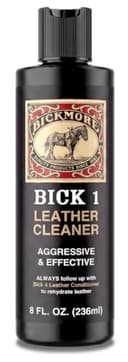
But Bickmore’s own directions add the caveat the title does not: if the item is very dirty, clean it with Bickmore Saddle Soap or Bick 1 first. So the honest answer to “is Bick 4 a cleaner?” is: partly, and the maker agrees it is not the cleaner for a genuinely grimy piece.
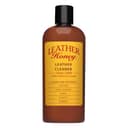
That is why there are four picks on this page rather than two. Each brand sells the bottle it wants you to clean with first, and they are not the same kind of product. Leather Honey’s cleaner is described as gentle, fragrance-free and EPA Safer Choice certified, and its bullets name handbags and purses directly. Bick 1’s own listing calls it an aggressive cleaner formulated for hardworking leather like equestrian tack, and names no handbags at all.
For a handbag, that makes Leather Honey’s cleaner the better first bottle even if you go on to condition with Bick 4 — which is a perfectly reasonable thing to do, and a good illustration of why buying a matched “set” is not automatically right. Bick 1 earns its place for the opposite bag: a neglected, salt-marked or thrifted piece where a gentle cleaner has already been tried and left the marks behind. Our cleaner roundup covers the full field.
Price, and what you are really paying for
Both sit in the inexpensive end of leather care — this is a category where the whole purchase costs less than a single restoration visit, and the live prices on the cards above are the current numbers rather than anything we have typed in. Bick 4 is the cheaper of the two conditioners as we write this, which makes the risk argument easier: the lower-risk bottle is also the lower-priced one.
The more useful framing is cost per year. Both are 8 oz, both are applied in a thin coat two or three times a year, and both will outlast most people’s patience for the ritual. Leather Honey’s six-month claim means fewer applications; Bick 4’s “repeat as necessary” may mean slightly more. Either way, a bottle of this stuff costs a rounding error against what a decent bag costs, which is the argument we make at length in are leather bags worth it.
How to use each one
The routine is the same shape for both and the dose is the part people get wrong. Clean first and let the bag dry fully. Then put conditioner on the cloth, never on the bag — a smear, not a pour. Work it in with the grain in thin, even passes, cover the whole panel so you do not leave a tide line, and leave it alone.
From there the two diverge slightly. Leather Honey wants time: a thin coat and several hours, ideally overnight, to absorb. Bickmore’s instruction for Bick 4 is to apply liberally, let it dry, then buff — the buff is the step that matters, and skipping it is how people end up with a patchy sheen. Repeat only if the leather still looks thirsty after it has fully dried.
Spot-test either one on the base or an inside corner first, and judge it the next morning rather than at ten minutes. Conditioner darkens temporarily while it is wet, and judging early is how people conclude they have ruined a bag they have not. Our conditioning how-to walks the full routine, and the over-application failure mode is covered in troubleshooting.
Which to buy, by bag
Cream, natural tan, white, pastel or any bag you want to keep exactly the shade you bought: Bick 4. This is not a close call.
A stiff, dry, mid-brown or black bag that needs reviving: Leather Honey. The stronger feed is the point, and there is no pale color at risk.
A rough-out or deliberately distressed finish: neither, at least not without a spot test you take seriously. Bickmore explicitly excludes those textures, and an oil-rich conditioner will smooth them.
Suede or nubuck: neither. Both makers exclude suede, and an oil or cream flattens the nap permanently.
One bottle for a bag plus boots and a car seat:Leather Honey, on range — its listing spans furniture, car seats, shoes, belts, saddles and tack. Just accept that the boots and the bag may both come out a shade deeper.
A bag you cannot identify the finish of: Bick 4, then the water test. Put a drop of water on a hidden spot: if it soaks in, the leather is absorbent and will take conditioner readily; if it beads, the finish is doing the work and conditioner mostly sits on top. The leather types guide covers how to tell what you have.
What about the rest of the Bickmore line?
Two questions come up often enough to answer here. Bick 4 vs Bick 1: Bick 1 is the cleaner, Bick 4 is the conditioner, and the brand’s own directions put them in that order. They are not alternatives. Bick 4 vs Bick 5: Bick 5 is listed by Bickmore as a cleaner- conditioner spray— a convenience format for a quick wipe-down, not a replacement for a proper conditioning pass.
The wider line also includes Gard-More water and stain repellent, a saddle soap with lanolin, neatsfoot oil, a distressed-leather conditioner, an exotic-leather product and a suede and nubuck cleaner. Most of those are boot, tack and furniture products rather than handbag products. The only two we would reach for on a bag are Bick 4 and, after it, Gard-More.
What neither of them does
Worth saying plainly, because both get credited with things no conditioner achieves. Neither one waterproofs a bag; conditioning adds a little repellency and nothing more, which is why Bickmore points you at a separate repellent. Neither one repairs damage that has already happened — conservation guidance is consistent that cracked fibers do not knit back together, whatever a label implies. And neither one fixes a bag that is peeling, because peeling is usually a coating delaminating rather than leather drying out.
What they do is keep leather in the state where cracking never starts. That is the entire job, it is worth doing two or three times a year, and the honest difference between these two bottles is which risk you would rather take: a shade change, or a lighter feed.