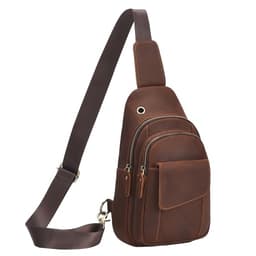
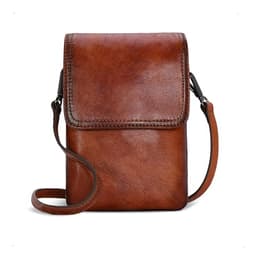
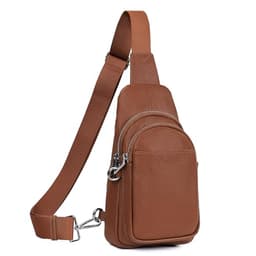
What you are actually buying
The listing describes the material as soft real leather. That is a genuine claim — the FTC’s guides on leather products require material that only looks like leather to be disclosed as imitation, so a bag sold plainly as leather is real hide. What the listing does not do is name a grade, and that silence is informative.
In practice, a soft real-leather bag in this price band is almost always corrected or split hide with a finish applied: the grade sold as “genuine leather.” That is a real, mid-tier material rather than a fake one. It will look and smell like leather, it will soften with use, and it will handle daily carry for years with basic care. What it will not do is develop the deep, uneven patina full-grain is bought for, because the surface it would need is not there. Our full-grain explainer sets out the difference properly.
We flag this not to talk you out of the bag but because the mismatch between what people expect from “real leather” and what a mid-grade bag actually does is the single most common disappointment in this category.
Size and how it carries
This is the part that makes it our default recommendation. The befen sits in the middle of the crossbody range: bigger than a phone bag, smaller than a sling that can take a tablet. In practice that means a phone, a card holder, keys, sunglasses and a couple of small extras sit in it comfortably without the bag bulging or slumping.
The listing states multiple zip and slip compartments, which matters more on a small bag than on a large one. A single-compartment crossbody turns into a bucket you dig through; a couple of internal divisions means the phone is always in the same place. That is the difference between a bag you like and a bag you tolerate.
The strap is adjustable and detachable, so it wears cross-body or shortened onto the shoulder. Because the body is soft rather than structured, it sits flat against you rather than standing away — comfortable, and the reason it slouches when it is not full.
Where it falls short
It slumps. An unstructured bag with two things in it looks like an unstructured bag with two things in it. If you want a crossbody that keeps a crisp shape empty, this is the wrong bag and a structured full-grain one is the right one.
The hardware is adequate, not heirloom.Plated rather than solid, and on a bag opened several times a day the zip is the component we would expect to give up first — long before the leather does. That is normal at this price and worth knowing rather than discovering.
No published dimensions.The listing does not state exact measurements, which is why our spec table says “Not published” rather than a number we invented. If you have a specific item that must fit — a large water bottle, a compact umbrella, a passport in a cover — treat this as a genuine unknown.
It will not patina. Covered above, but worth repeating, because it is the reason some buyers should spend more rather than less.
Who should buy it
Buy it if you want one everyday crossbody in real leather, you carry a normal daily kit rather than a laptop, and you would rather spend the difference on something else. Buy it if you are buying your first real leather bag and want to find out whether you like the material before committing to a full-grain price. Buy it as a gift for someone whose taste you half-know, because a mid-brown or black soft crossbody is about as low-risk as bag gifting gets — our gift guide covers that reasoning.
Who should not
Skip it if a patina is the point — go full-grain instead. Skip it if you need the bag to hold its shape empty, or to carry a tablet, or to survive a genuinely rough life. And skip it if security is your main driver: a standard zip closure is a deterrent rather than a defense, and the purpose-built anti-theft options in our travel roundup do that job properly.
Living with it
Care is minimal and the payoff is large. Wipe the dust off when you notice it, keep it off wet surfaces, and condition it once or twice a year with a thin coat — mid-grade leather absorbs less than full-grain does, so heavy application just sits on the surface and collects grit. The strap and the area around the zip are where wear shows first, so that is where to look when you are deciding whether it is time. Our conditioning guide covers the amounts.