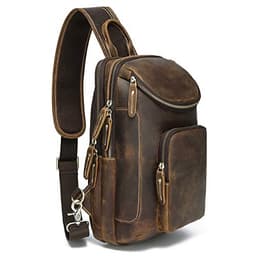
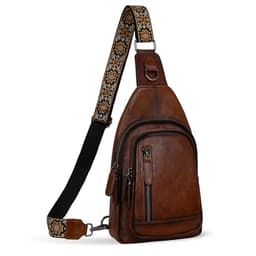
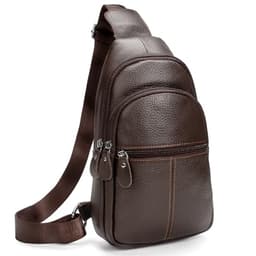
What you are actually buying
The listing sells this as genuine leather, and the material field says cowhide. Both are real claims — the FTC’s guides on leather products require material that merely looks like leather to be disclosed as imitation, so a bag described plainly as leather is hide rather than a coating. What the listing does not do is name a grade beyond “genuine,” and that word is a grade, not a compliment.
In this price band, genuine leather almost always means a corrected or split layer of the hide with a finish sprayed over the top. It is real leather, it wears for years with basic care, and it will not develop the deep patina that people who read about leather are usually hoping for. Our explainer on what genuine leather means sets out exactly where the grade sits and why the label is so widely misread. If patina is the reason you want a leather bag, this is the wrong bag and the full-grain slings are the right page.
The shape is the actual argument
Most men’s leather crossbodies are one of two things: a small messenger with a flap, or a chest rig that looks like it belongs on a motorbike. The BULLCAPTAIN is a vertical sling — taller than it is wide, worn on a single adjustable strap, sitting either high on the chest or round on the back.
The vertical layout matters more than it sounds. A phone in a horizontal bag lies flat under everything else; in a vertical one it stands in its own slot and comes out first. With a wallet, keys and a charger in the remaining pockets, you get an arrangement where nothing has to be moved to reach anything — which is the entire practical benefit of a small bag over a jacket pocket.
The trade-off is that it is unmistakably a sling, and slings read as utility. Worn over a jacket it looks like you are going somewhere. If you want a small leather bag that reads as an accessory rather than equipment, our sling versus crossbody comparison works through the difference properly.
Where it runs out
Capacity, and it runs out abruptly. The listing claims a 7.9-inch iPad mini and stops there, which is the honest ceiling — this is a phone, wallet, keys, charger and perhaps a small water bottle bag. Put a paperback and a notebook in and the zip is under strain and the bag bulges away from your body.
That is not a defect at this price; it is the size the bag is. But it is the single most common reason someone is disappointed by a sling, so it is worth being blunt: if your daily carry includes anything with pages, buy the larger crossbody instead and skip the intermediate step.
The second limit is finish. The hardware is plated rather than solid, and the zip is the component most likely to fail before the leather does. That is normal for the money — our hardware guide covers what a branded zip pull tells you and why it is worth looking for in the listing photos.
Who should buy it
Someone who wants to stop carrying a bulging jacket pocket, who does not want a backpack for a trip to the shops, and who would rather the bag not announce itself. It is also a genuinely good first leather bag: cheap enough that a mistake does not sting, real enough that you learn what leather feels like as it softens.
It suits travel days particularly well — worn on the chest, the opening is under your eyes in a crowd. It is not, however, an anti-theft bag, and it does not claim to be. If that is the requirement, the picks on our travel crossbody page state their security features explicitly and we are careful there about what “anti-theft” does and does not mean.
Who should not
Anyone who wants a bag that will look better in five years — the grade will not do that. Anyone carrying a full-size tablet. Anyone who needs the bag to work with tailoring. And anyone who has been burned by a slim bag before and secretly wants more room, because you will fill this one on day two and be annoyed by week three.
Making it last
Corrected-grain leather like this responds to less care than full-grain, not more. Keep it out of standing water, wipe dust off before it gets ground into the grain, and give it a thin coat of conditioner once or twice a year — the strap and the area around the zip first, since those flex most. Our conditioning guide covers the amounts, which are smaller than most people apply.