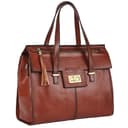
The five trade-offs
1. Comfort, over a long day
Crossbody, decisively, and it is not close once there is weight involved. Spreading a load diagonally across your torso lets your frame carry it; hanging the same load from one shoulder makes a single muscle group hold it for as long as you are out, which is why people unconsciously hitch a shoulder bag up every few minutes.
The caveat is strap width. A crossbody puts everything on one strap, so a narrow strap concentrates the weight into a line across your chest. If you are buying at the larger end, strap width matters more than the leather grade does.
2. Security, in a crowd
Crossbody again. The bag sits in front of your hip where you can see it and feel it, the strap cannot be lifted off a shoulder, and you can swing it fully to the front in a second. A shoulder bag can be slipped off a shoulder without much resistance, which is exactly why travel advice always ends up recommending the diagonal carry. Our travel crossbody page covers what the “anti-theft” label adds on top of that, and what it does not.
3. Access speed
Shoulder bag, narrowly. It sits at hand height under your arm, so opening it is a single motion; a crossbody worn at the hip usually needs to be pulled round first. If you are in and out of the bag constantly — a card, a phone, a notebook — that difference adds up over a day.
4. Formality
Shoulder bag, clearly. A diagonal strap crosses the body and interrupts the line of a coat or a jacket, which is why crossbodies read casual almost regardless of how good the leather is. A shoulder bag hangs vertically and leaves the outfit intact. If the bag is going into meetings or out to dinner, this is the reason to choose it, and it is a legitimate one.
5. Capacity, per unit of discomfort
Roughly even at small sizes and increasingly crossbody as bags get larger. A shoulder bag can be made bigger without looking odd — the shape scales into a tote — but the discomfort scales with it. A crossbody carries a heavier load more comfortably and starts looking bulky sooner. Somewhere around 12 inches wide, both shapes start being honest about wanting to be a tote instead, which is the subject of our tote versus shoulder bag comparison.
What about a bag that does both?
Plenty of bags ship with a long, detachable, adjustable strap and are sold as convertible. That is genuinely useful and it is worth having — but it does not make the two carries equivalent, for a reason most listings will not tell you.
A bag designed as a shoulder bag has its hardware, proportions and stiffness tuned for hanging vertically. Worn diagonally, it often sits at an awkward angle, gapes at the top, or presses a corner into your hip. A bag designed as a crossbody worn on a shortened strap usually looks fine but sits high and small under the arm.
The practical rule: buy for the carry you will use four days out of five, and treat the other as a bonus. Our guide to wearing a crossbody covers strap length properly, including the difference over and under a coat.
The grade question is different on each side
This is the part that is specific to leather and gets missed in generic comparisons.
A crossbody strap is a stress point that flexes every single day and takes body heat and sweat where it crosses your chest. That is exactly the condition that dries hide out, and it is why a crossbody in a thin or heavily corrected leather tends to fail at the strap long before the body shows wear. Buying up a grade genuinely buys years here.
A shoulder bagputs far less sustained stress on its strap but shows the leather much more, because the whole panel faces outward and hangs flat. This is the shape where a soft, slouchy hide looks best and where full-grain earns its money visually — it is a bag you look at rather than a bag that works. Our full-grain versus top-grain guide is the ten-minute version of what that upgrade buys.
Which one to buy
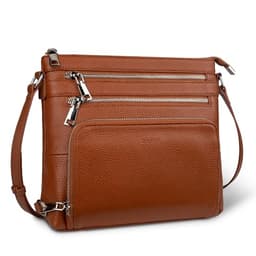
Buy the crossbody if you are on your feet, if you use public transport, if you travel, if you carry anything over about two pounds, or if you have ever taken a bag off because your shoulder hurt. That covers most people most of the time, and it is why our top pick above is a crossbody.
Buy the shoulder bagif the bag is mostly going between a car, a desk and a restaurant, if you open it constantly, or if the look genuinely matters to you. It is not the practical choice and it does not need to be — a bag you like carrying is a bag you carry.
On the crossbody side, the befen is the medium everyday size at the lowest sensible price, and the HESHE is the answer if you need real volume without moving to a tote. On the shoulder side, the Portland Leather Naomi is the slouchy everyday shape from a maker people actually recognize — our full brand review is here — and the Banuce is the full-grain upgrade if you want a bag that improves rather than one that simply lasts.
If you are still deciding on size rather than shape, do that first: our sizing guide takes three minutes and rules out most of the market.
If you have decided on shoulder carry
Having read the trade-offs, if the shoulder bag is the shape you want for work, the picks are on a page of their own. Our leather shoulder bags for work roundup ranks the real-leather options on carry position first, then on whether the bag holds a shape and closes, which is where most of them fall down.