The load maths
A backpack splits the weight across both shoulders and holds it close to your spine. A messenger puts all of it on one shoulder and lets it hang across your back, where it wants to swing forward every time you lean.
With three or four pounds of bag and laptop that difference is noticeable but livable. With a full-grain leather bag — which is heavy empty — plus a 15-inch machine, a charger and a notebook, it becomes the deciding factor for most people who carry daily. Leather amplifies this comparison in a way nylon does not, because the bag itself is a meaningful share of the total.
Where the messenger claws some back: a wide, well-designed strap spreads load far better than a thin one, and a bag worn tight to the body rather than hanging low moves much less. A messenger you have adjusted properly is a genuinely different experience from one worn at the length it arrived at.
Access, which is where the messenger wins outright
A messenger swings from your back to your front in one motion and opens while it is still on you. That is trivial once a day and transformative if you are in and out of the bag constantly — a photographer, a courier, a teacher moving between rooms, anyone who works standing up.
A backpack has to come off, go somewhere and be opened. In a coffee shop that is nothing. On a crowded train, in the rain, on a station platform, it is a genuine irritation, and it is the single thing backpack owners complain about most.
The caveat: flap-over messengers are slower to open than they look. A buckled flap is two actions before you reach anything, which partly cancels the advantage. A zip-top or magnetic-catch messenger keeps it.
Cycling and moving fast
A backpack is the safer bag on a bike for anything heavy, because the load sits still. A messenger’s original design brief was exactly this — couriers wanted single-shoulder access at speed — but a courier bag has a stabilizer strap across the chest, and almost no leather messenger does.
Without that strap, a loaded leather messenger swings forward under braking and drags on one shoulder up a hill. If you cycle to work with a laptop, buy the backpack. If your commute is walking and transit, this consideration does not apply to you at all.
How each one looks
A leather messenger reads a step more formal than a leather backpack in most rooms, and a step less formal than a briefcase. That middle position is genuinely useful: it works in a creative office, at a client meeting that is not a boardroom, and on a campus, without looking wrong in any of them.
A structured leather backpack in a dark color is now fine in most offices — more so than it was five years ago — but it is still the shape most likely to read young. Our briefcase versus backpack comparison covers where that matters, and our briefcase versus messenger piece covers the other edge of the same triangle.
Aging: the one place leather changes the argument
A messenger ages beautifully. The flap develops a soft fold line, the strap darkens where it crosses your body, and the corners round off. Nothing about the shape fights the material.
A backpack has two structural disadvantages. The straps flex constantly at the anchor points, and the back panel is the only part of any bag exposed to sweat — and salt draws oils out of hide, leaving it stiff and eventually cracked if it is never conditioned. Neither is a reason to avoid a leather backpack; both are reasons to condition the straps and the back panel first, twice a year, which is the opposite of what most owners do. Our conditioning guide covers the routine.
Capacity
Backpacks win on volume for the same weight of leather, because the shape is deeper and the load sits over your hips rather than swinging. A leather messenger that is genuinely large — and they exist, up to an 18-inch laptop — becomes unwieldy on one shoulder long before it becomes full.
If your carry is a laptop, a charger and a notebook, either shape handles it. If it also includes gym kit, lunch and a sweater, the backpack is the only sensible answer.
The honest verdict
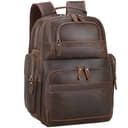
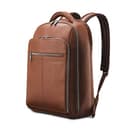
Buy the backpack if you cycle, if you walk more than about twenty minutes, if your carry is heavy or bulky, or if one shoulder already objects. The TIDING full-grain is the buy-once version; the Samsonite is the one that looks most at home in a conventional office.
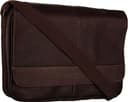
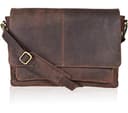
Buy the messenger if you are in and out of the bag all day, if your carry is a laptop and paper rather than a load, or if you want something that reads a notch more grown-up without carrying a case. The Kenneth Cole full-grain is our pick; the Oak Leathers is the value route into real hide.
If you are undecided and your commute is short, buy the messenger — the access advantage is something you feel every day, while the load penalty only bites over distance. If your commute is long, the reverse is true and it is not close.