The formality question, without pretending it does not exist
A leather backpack is now unremarkable in most workplaces. It is still not unremarkable in all of them. Law, finance, formal client meetings, interviews, court — in those rooms a briefcase reads as “established” and a backpack reads as “early career,” whether or not that is fair.
The practical test is not what your colleagues carry, it is what the people you are trying to persuade carry. If you spend your week among peers, carry what is comfortable. If your week involves walking into rooms where you need to be taken seriously by strangers, the briefcase is doing work for you that has nothing to do with holding a laptop. Our briefcases for lawyers page is the version of this written for the most formal end of the scale.
One nuance worth knowing: a structured leather backpack in a dark color with minimal external pockets clears the formality bar far more easily than a distressed brown rucksack. The shape matters less than how much the bag looks like outdoor equipment.
What a briefcase genuinely does better
Protects a laptop
A structured case puts a rigid shell around the machine and a padded compartment inside it. When you set the bag on a floor, the shell takes the impact. Backpacks vary far more here: a good one has a suspended padded sleeve that keeps the laptop off the base, but plenty of leather backpacks have a plain compartment where the machine rests on the bottom of the bag.
Handles paper
Documents, folders, a legal pad and a signed contract all travel flat in a briefcase and crumple in a backpack. If your work still involves paper you hand to someone, this is not a small point — and expandable cases exist precisely for it.
Access
You open a briefcase on a table without taking it off anything. A backpack comes off, goes somewhere and gets opened blind or turned round. Across a day with several meetings, that adds up.
What a backpack genuinely does better
Your body
Two straps halve the per-shoulder load and put it over your center of gravity. With a leather bag this matters more than with nylon, because the bag itself is already heavy — a full-grain case with a 16-inch laptop in it is a significant asymmetric weight to carry every day for years.
Distance and stairs
Anything involving a real walk, a bike, transit changes or station stairs favors the backpack decisively. Both hands stay free for handrails, tickets, umbrellas and coffee.
Capacity for bulk
Gym kit, a packed lunch, a change of shoes, a sweater. A briefcase is a flat object and resists all of that; a backpack absorbs it without looking stuffed. If your bag doubles as everything-you-need-today, the backpack wins on volume for the same weight of leather.
The commute decides it more often than the office does
Our rule of thumb: count the minutes the bag spends on your body while you are moving. Under ten minutes each way, choose on formality — the load is irrelevant, so buy the bag that suits the rooms you walk into. Over twenty minutes on foot or on transit, choose the backpack unless the dress code genuinely forbids it, because you will feel a one-shoulder leather bag by the end of the week.
Between the two, the deciding factor is what you carry. A laptop plus a charger plus a notebook is a backpack load. A laptop and a folder is a briefcase load. The same reasoning drives our work bag pillar, which compares every shape against the same journey.
How each one ages in leather
A briefcase wears at the handle, the base corners and the flap edge, and all three darken attractively. A structured case also holds its shape, so it looks deliberate for its whole life.
A leather backpack wears at the shoulder straps and the back panel, and the back panel is the one part of any bag exposed to sweat. Salt draws oils out of hide and leaves it stiff, so a leather backpack needs its straps and back panel conditioned before its front panels — which is the opposite of what most owners do. Our conditioning guide covers the routine, and it is the single habit that decides whether a leather backpack lasts a decade.
The honest verdict
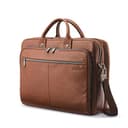
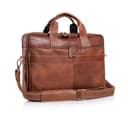
Buy the briefcase if you drive or your commute is short, if your work involves paper or formal meetings, or if protecting an expensive laptop is the priority. The Samsonite classic toploader is the safe, structured, warranty-backed answer; the KomalC is the value route if you would rather have more and better leather than a rigid shell.
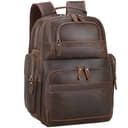
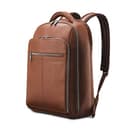
Buy the backpack if you walk, cycle or use transit for more than about twenty minutes, if you carry more than a laptop and a folder, or if your shoulder has already registered a complaint. The TIDING full-grain is the buy-once option; the Samsonite classic backpack is the one that looks most at home in a formal office while still being a backpack.
And the answer a lot of people land on eventually: a backpack for the commute, a slim briefcase or portfolio for the days with meetings. Two bags for the price of one premium one, and neither is compromised.