Why almost no diaper bag is leather
Three forces push this category toward synthetics, and only one of them is about money. The first is weight. A diaper bag is carried loaded, often for hours, frequently by someone already carrying a child. Full-grain leather is heavy before you put anything in it — the leather pick on this page is 3.3 pounds empty, which is roughly a full bottle of water of pure penalty.
The second is cleaning, covered below, and the third is construction. Insulated bottle sleeves, a dry/wet separation pocket and a foldable changing pad are all built from laminated fabric. Adding them to a leather bag means sewing synthetic components into a hide shell, which is why the leather bags that do exist here tend to skip the diaper-specific parts entirely and simply be good backpacks.
None of that makes a synthetic diaper bag a bad purchase. It makes the word “leather” in the title a claim worth checking. Under the FTC’s leather guides, material that looks like leather but is not has to be disclosed as imitation — and most of these listings do disclose it, several bullet points down, after the title has already done its work. Our guide to spotting fake leather covers the checks in full.
The wipe-clean problem
This is the real reason leather is rare here, and it deserves a straight answer rather than a workaround. A coated synthetic has a sealed plastic surface. Milk, puree and worse sit on top of it, and a damp cloth removes them completely. Leather does not work that way: the surface is porous, it absorbs, and the more absorbent the grade the more it absorbs. Full-grain — the grade that ages best — is the least sealed of all.
You can still own a leather bag through this stage of life. What you cannot do is clean it the way you would clean a wipe-down bag. Spills get blotted immediately rather than rubbed, water is used sparingly, and the bag dries at room temperature away from any heat source. Museum conservation guidance on leather is unusually relevant here, because it is written for exactly this problem: gentle, minimal intervention beats aggressive cleaning every time, and over-treating causes more damage than the original stain. Our cleaning guide walks through the routine.
The practical compromise most leather-bag parents land on is a separate wipeable pouch inside the leather bag for the genuinely messy items, so the hide never meets the mess. It costs a few pounds and solves most of the problem.
What the diaper-bag kit actually is
Strip away the marketing and a purpose-built diaper bag adds five things to an ordinary backpack. A foldable changing pad, so you are not laying a baby on a public surface. Insulated bottle pockets, which hold temperature for a few hours rather than all day. A dry/wet separation pocket for a soiled change of clothes. Stroller straps, which clip the bag to a pushchair handle so you are not wearing it. And a wide, one-handed opening, because one hand is often all you have.
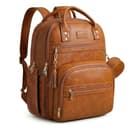
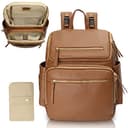
Judge any bag in this category on those five, and the picture clarifies quickly. The ROSEGIN has all five plus a laptop slot. The Omanmoli has all five in a smaller body, with the useful twist that its insulated pockets detach when bottles stop being part of the day. The CHAYELL has none of them stated on its listing — it is a leather backpack that Amazon files under diaper bags — and the TIDING makes no claim to be one at all.
That is not a criticism of the leather picks so much as a description of the trade. You are choosing between a bag built around the eighteen months when bottles matter, and a bag built to still be worth carrying in ten years.
The two honest routes
Route one: buy the synthetic, on purpose.If the bag will be wiped down weekly, thrown in a car footwell, and handed between two parents, the coated bags on this page are the correct answer and cost less than a single real-leather crossbody. Buy one that discloses its material honestly, use it hard for two years, and do not feel you compromised — you bought the right tool.
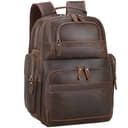
Route two: buy leather, and add the kit yourself. A changing pad costs very little and lives in any bag. Insulated bottle sleeves are sold separately. Stroller clips are a universal accessory. Buy the bag you actually want to carry, add the three parts, and you end up with something that does not announce itself as baby equipment and does not get retired when the nappies stop. This is why the TIDING full-grain backpack is on a diaper-bag page: it is the buy-once version of the same purchase.
What we would not do is the third route the market pushes hardest — paying a leather price for a bag that is not leather. That is the outcome the material line exists to prevent, and it is entirely avoidable.
What to check on the listing
The material field, not the title.Open the structured product details and read what the bag is made of. If the title says leather and the details say polyurethane, the details are the answer. Several of the best-selling “leather” diaper bags on Amazon describe themselves in their own bullet points as tear-resistant fabric — the word leather appears only in the title.
Empty weight. Published weights in this category range from around 2.6 pounds to well over 3, and you will carry that difference for hours at a time. It is also the most reliable proxy for material: a large bag that weighs very little is not hide.
Whether the changing pad is included. Photographs routinely show accessories that are sold separately. If the bullets do not list the pad with a size, assume it is not in the box.
The laptop claim.A “laptop pocket” and a padded laptop compartment are different things, and only one of them protects a machine. This matters more than it sounds, because the diaper bag often becomes the work bag. Our work backpack roundup explains what suspended padding actually is.
Which one to buy
If you came here because you want leather, buy the CHAYELL and add a changing pad. It is the only pick on this page whose listing states a real grade — full-grain hair-on cowhide — and one of very few in the whole category that publishes its dimensions and weight rather than leaving you to guess from photographs. Accept that you are supplying the diaper-specific parts yourself, and that a hair-on hide is not something you scrub.
If you came here because you want the best diaper bag and were merely drawn to the look, buy the ROSEGIN. Twenty pockets, three insulated bottle pockets, a dry/wet pocket, a changing pad and a 15.6-inch laptop slot is a genuinely complete specification, and the listing is honest about being faux leather rather than burying it. The Omanmoli is the pick if 35 liters sounds like too much bag: smaller, lighter, and its insulated pockets come out when you are done with bottles.
And if the diaper years are the reason you are buying a bag but not the reason you want one, the TIDING full-grain backpack is the honest long game. It carries a 15.6-inch laptop, it will outlast every other bag on this page, and nobody will be able to tell what it was bought for. Compare it against the rest of the field in our work backpacks roundup before you commit.
Looking after a leather bag that lives with a baby
Blot, never rub, and deal with spills the same day — a fresh spill on leather is a cleaning job, a week-old one is a stain. Keep the bag off radiators and out of hot cars, because heat is what dries hide out and cracks it, not use. Condition it two or three times a year rather than annually, since this bag gets handled far more than a bag that commutes.
Do not store it loaded. A diaper bag spends its life full and heavy, and hanging it that way on a hook for months is what stretches strap attachments permanently. Empty it, stuff it lightly and stand it upright. Our storage guide covers the humidity side, and the troubleshooting guide covers what to do about the smells this bag is uniquely prone to.