What the brand premium actually buys
Three things, and it is worth naming them precisely rather than treating “brand” as a vague good.
Consistency. Two units of a Samsonite case are the same bag. That sounds trivial until you have read reviews of a handmade marketplace case where the color, the hardware finish and occasionally the dimensions vary between orders. If you are buying without handling the bag first, consistency has genuine value.
Recourse. An established manufacturer has a warranty process and a customer-service function. A marketplace maker has a returns window and, after that, goodwill. On a bag you intend to carry daily for years, the difference is not nothing.
Design maturity. Samsonite has been building cases for a very long time, and it shows in the details that do not photograph: where the handle sits relative to the loaded balance point, how the shoulder strap attaches, how the case behaves standing up. Those are the things a first-time maker gets subtly wrong.
Where the leather actually sits
Here is the trade. The listing does not name a leather grade beyond leather, and our spec table reflects that rather than upgrading it. In this price band from a luggage brand, that almost always means a corrected, finished hide — real leather, evenly surfaced, sealed for durability and consistency.
That is a deliberate choice on Samsonite’s part, not a cost dodge: a corrected finish resists staining and scuffing better than an open full-grain surface, and it keeps every unit looking identical. For a business case that has to look presentable for years, those are reasonable priorities.
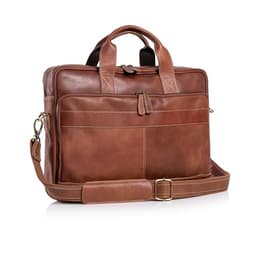
The consequence is that it will not patina. It will look much as it does now for a long time and then start to show wear at the corners rather than deepening into character. If you want a bag that becomes yours, this is the wrong bag — and the KomalC full-grain buffalo case in our under-$300 roundup costs a fraction as much and does exactly that.
Structure and daily use
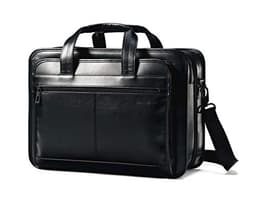
This is where the case earns its keep. It is a genuine structured briefcase: it stands upright beside a desk without propping, it holds its rectangle loaded or empty, and the laptop compartment is built into the design rather than added as a slot.
Toploader means the case opens from the top rather than clamshelling flat, which is faster for grabbing a laptop and less convenient for packing papers neatly. If your day is laptop-in, laptop-out at several locations, that is the right configuration. If it is files and documents, the expandable Samsonite is the better sibling — same brand, different job.
The honest weaknesses
It is heavy. Structure is material, and a structured leather case is a real weight before you put anything in it. Add a laptop and a charger and a twenty-minute walk from a station stops being pleasant. If your commute is on foot, our work backpack roundup is the kinder answer, and we would rather say so than sell you a bag you carry resentfully.
You pay for the name.Not unreasonably — see the three things above — but a full-grain marketplace case can be had for a fraction of this and will age better. What it will not give you is the consistency or the recourse.
The grade is unstated.Our spec table says “Not published” because the listing does not say. That is a finding about disclosure rather than a gap in our research, and a buyer for whom grade is the priority should treat it as a reason to look elsewhere.
Who should buy it
Buy it if you want a structured leather briefcase and you want the decision over with. Buy it if you work somewhere formal and the bag needs to look correct rather than characterful. Buy it if you drive or take a short transit ride rather than walking twenty minutes. Buy it if a warranty process matters to you more than a patina does.
Who should not
Skip it if the leather itself is the point — go full-grain and spend less. Skip it if you walk a long commute, because two straps solve a problem this bag cannot. Skip it if you carry a 17-inch machine, which is a separate search covered in our 17-inch roundup. And skip it if you want a bag that reads as anything other than professional; a vintage satchel does that job and this does not.
Living with it
A finished, corrected hide needs less conditioning than full-grain does, because there is a sealed surface between the conditioner and the leather. Once or twice a year is plenty, applied thinly, with attention to the handle and the base corners — the two places a briefcase wears first. Do not use heavy oils on a finished business case; they sit on the surface, attract grit and can leave a sheen you cannot remove. Our conditioner comparison covers which products belong on which leather.