What makes a vintage finish good rather than fake
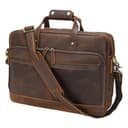
The honest version of the vintage look is a full-grain hide with a variegated dye and a light wax or oil finish. Because the natural surface is intact, the color already sits unevenly, and handling deepens it further. Every mark you add joins the ones the finish started with, which is why a good vintage bag looks better after a year rather than merely older.
The dishonest version is a corrected hide — surface sanded off, grain embossed back on, an antiqued finish sprayed over the top. It photographs identically and behaves completely differently: the finish is a layer, and layers wear through at corners and edges rather than blending in. Our guide to spotting fake leather covers the tells, and the shortcut is the same as always: a listing that names the grade is telling you something, and one that only says “vintage leather” is telling you something else.
Soft-sided, and what that costs you
Almost everything in this category is a soft or semi-soft satchel rather than a rigid case, and that is inherent to the style. A vintage briefcase is descended from a doctor’s bag or a school satchel, not from an executive attaché case, so it flexes around its contents and folds where it is carried.
The consequence is protection. A laptop in a soft satchel takes more of any knock than one in a structured case, and the bag sags visibly when it is not full. If you carry an expensive machine and set your bag down hard, the honest answer is a structured case from our under-$300 roundup rather than a vintage satchel with a sleeve inside it. If your cargo is papers, a tablet and a laptop that lives in a sleeve anyway, the trade is fine.
Handmade means variable
Three of these picks are described as handmade, and that word cuts both ways. On the good side: heavier stitching at the stress points, thicker hide than a factory bag at the same price, and a bag that can often be repaired rather than replaced.
On the other side: unit-to-unit variation is real. Color depth, hardware finish and even dimensions can differ between two bags from the same listing, because they were cut from different parts of different hides by different hands. If you need two bags to match, or you have an exact expectation of shade, buy accordingly — and read recent reviews rather than the oldest ones, since makers at this scale change suppliers.
Which one to buy
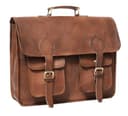
The Leather Room case is our overall pick and, for what it is, remarkable value: full-grain, handmade, a stated 15.6-inch laptop fit, and published exterior dimensions — which is rarer in this category than it should be.
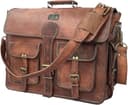
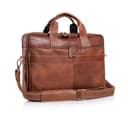
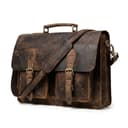
The two cuero bags are the same idea at a larger size. Take the vintage-brown version for the classic look, or the retro-brown one if you want a darker, more weathered finish that hides handling marks better. Both are 18-inch bags, which is generous even for a big laptop. The KomalC is the buffalo-hide option — a coarser, more pronounced grain than cowhide, and the most rugged surface here. And the Masa Kawa is the pick if you carry a 17-inch machine, a size most of this category ignores; our 17-inch roundup covers that problem in full.
Caring for a vintage finish
Less than you would think, and gently. A vintage finish is doing exactly what it should when it darkens at the handle and lightens at the corners — that is the patina you paid for, and over-conditioning flattens it by evening out the color you bought unevenness for.
Condition once or twice a year with a thin coat, and resist the urge to “fix” every mark. Avoid heavy oils and pastes entirely: mink oil and similar products darken a vintage hide dramatically and unevenly, which reads as a stain rather than age. Our conditioner versus mink oil comparison explains where that line sits, and the patina guide covers what is actually happening to the surface.