What a vintage finish actually is
Almost always a treatment rather than an age. A hide is dyed unevenly and given a light wax or oil finish so the color already sits deeper in some places than others, which reads as wear. On full-grain that is a genuinely good idea: because the natural surface is intact and unsealed, every mark you add joins the unevenness the finish started with rather than sitting on top of it.
The version to avoid is an antiqued effect sprayed onto corrected leather — surface sanded away, grain embossed back on, finish applied over the top. It photographs the same and behaves completely differently: the finish is a layer, and layers wear through at corners rather than blending in. The shortcut, as always, is that a listing naming the grade is telling you something. Our guide to spotting fake leather covers the rest.
Access is the thing people underestimate
Rucksack styling means flap closures, buckles and sometimes a drawstring underneath. That is authentic to the shape, it looks right, and it is slower than a zip every single time you use it. On a bag you open twice a day it is charming; on one you open every twenty minutes it is a genuine irritation.
Be honest about which you are. If you are in and out of the bag constantly, a zip-top leather backpack from our work backpack roundup will make you happier than a beautiful rucksack you resent opening. If the bag gets opened at each end of a commute, the flap costs you nothing.
Weight, and the full-grain trade
Full-grain is thicker than corrected leather because nothing has been sanded away, and a backpack is a large panel of it. These bags are heavy empty — noticeably heavier than a comparable canvas pack and dramatically heavier than nylon.
The compensation is that two straps distribute that weight across both shoulders and over your spine, which is exactly why a heavy bag is more tolerable as a backpack than as a briefcase. It is also why we would push anyone carrying a large laptop toward this shape rather than a satchel — covered in our 17-inch roundup.
Which one to buy
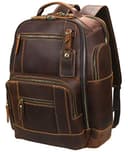
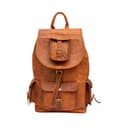
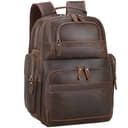
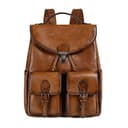
The LANNSYNE is our overall pick and the most genuinely rucksack-shaped bag here, with a published 24-liter capacity — a figure almost nobody in this category states. That number is the reason it leads: it is the only pick where you can compare capacity against a technical pack rather than guessing from photos.
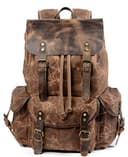
The TWARA is the value choice by a wide margin, full-grain with a stated 17-inch laptop fit and published dimensions, at roughly half the price of the branded alternatives. The TIDING is the one to buy if this is a work bag first and a vintage bag second — more structured, more organized, less romantic. The COOLCY is the smaller, more purse-scaled shape for a lighter carry, and the WUDON is the waxed-canvas-and-leather option for anyone who wants the look somewhere genuinely wet.
Letting it age properly
A vintage full-grain backpack is the bag on this site that rewards being left alone the most. The finish is designed to deepen at the flap and the straps and lighten at the corners that rub, and every instinct to “fix” that with product works against it.
Condition once or twice a year with a thin coat and stop there. Over-conditioning evens out precisely the unevenness you paid for, and heavy oils like mink oil darken a vintage hide dramatically and unevenly — which reads as a stain, not age. Our conditioner comparison explains where that line sits, and the patina guide covers what the surface is actually doing.