What Bickmore actually claims
Worth separating from what the internet says about it. Bickmore's own product page for the 8 oz bottle makes four claims that matter, and they are the spine of this review:
- It will not darken leather.“Unlike most leather conditioners, Bick 4 Leather Conditioner will NOT darken your leather.” That is the headline and the whole reason to choose it.
- It is wax-free.“Unlike other brands, Bick 4 is a completely wax-free product,” with the stated consequence that “the leather pores will not seal up.”
- It is for smooth finished leather.The brand describes it as “essential for maintaining all types of smooth finished leather,” and names handbags specifically.
- It is not for four kinds of hide.“Do not use on suede, rough-out, distressed or napped leathers.” That is the brand's own exclusion list, and it is the line that decides whether this is the right product for your bag.
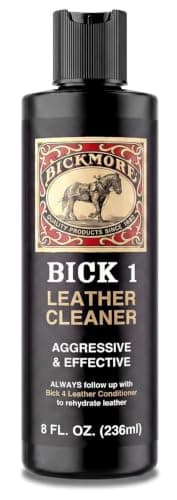
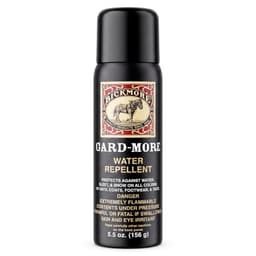
It also publishes directions worth following literally: “Apply liberally with a clean cloth. Let dry and buff. Repeat as necessary,” with two sequencing instructions — clean first with saddle soap or Bick 1 “if item is very dirty,” and apply Gard-More afterwards “for extra protection and waterproofing.”
Why “wax-free” is the real story
The non-darkening claim gets the attention, but wax-free is the claim that explains the behavior, and the two are connected.
Darkening in a conditioner is mostly an optical effect, not a dye. When oils and waxes fill the microscopic voids near the surface of a hide, the surface stops scattering light and starts transmitting it — the same reason a paper towel goes translucent and dark when it gets wet. The more a product saturates and sits in the surface, the more it darkens. A product formulated to avoid that has to carry less of the heavy, pore-filling material, and wax is the heaviest of it.
That has a direct, honest consequence: Bick 4 conditions more lightly than an oil-rich dressing, by design. You get color stability and a surface that still breathes; you do not get the deep, long-interval feed of a heavy oil. On a bag that has been neglected for years and gone stiff, Bick 4 is not the fastest route back. On a bag you intend to keep looking exactly as it looks now, it is the only sensible choice.
It also means Bick 4 does not waterproof. The brand is straightforward about this — it tells you to apply Gard-More afterwards for water and stain protection, which is an admission that the conditioner is not doing that job. If water is your concern, our guide to waterproofing a leather bag covers what actually works and what the trade-off is, because every genuine water repellent changes the hand of the leather somewhat.
The exclusion list, read properly
“Do not use on suede, rough-out, distressed or napped leathers” is four categories, and two of them catch people out.
Suede and nappedare the obvious ones — a liquid conditioner mats a raised fiber nap and the texture does not come back. If your bag is suede, this is the wrong product and our suede bag care page is the right page.
Rough-outis hide used flesh-side out — the same problem as suede, differently named, and more common on rugged bags than people expect.
Distressedis the one that catches buyers of exactly the bags this site covers most. A great many “vintage,” “crazy horse” and “oil-tanned” bags in this market are distressed hides: finished with oils and waxes so they lighten where they flex and darken where they are rubbed. Conditioning one with a product designed to leave color unchanged works against the entire point of the finish, and Bickmore maintains a separate Distressed Leather Conditioner for them rather than stretching Bick 4 to cover it. If your bag is one of these, read our pages on distressed leather and oil-tanned leather before you condition it at all — the second one explains why these hides need far less, far less often, but not never.
Which leaves the question of what Bick 4 is for: smooth finished leather. Pigmented and sealed bags, calfskin, saffiano and similar pressed finishes, mainstream handbags, and above all pale ones. On our registry that covers the majority of the bags we track.
How much to use, and how often
Bickmore says “apply liberally,” which is unusual — most conditioner makers say the opposite — and it follows from the wax-free formulation. There is less heavy material to leave a residue, so the failure mode of over-application is milder here than with an oil dressing. That is genuinely easier to live with for a nervous first-timer.
Even so, two habits matter more than the dose. Spot-test first, every time, on a hidden area: the base of the bag or the inside of a flap. Every hide reacts slightly differently and a non-darkening claim is a claim about the formula, not a guarantee about your particular bag. And treat the whole panel rather than a patch, because a conditioned spot surrounded by unconditioned leather reads as a mark even when nothing is wrong.
On frequency: twice a year is plenty for a bag in normal indoor use, more if it is out in dry heat or handled constantly. Our conditioning guide has the full routine and the tell that a bag is actually asking for it, which is a dullness that returns within a day of being buffed rather than a date on a calendar.
There is a commercial reason to keep to it, too. A hide that cracks because it was never conditioned is the one failure a bag warranty reliably will notcover — it reads as neglect rather than a manufacturing defect. Our guide to leather bag warranties and lifetime guarantees sets out which failures are covered, which are always yours, and why “lifetime” is not a length of time.
One sequencing point people get wrong: conditioner is not a cleaner. Bickmore says to clean first with saddle soap or Bick 1 if the item is very dirty, and that is the right order — conditioning over grime drives the grime in. The cleaning guide covers the step that should come first.
Where it sits against the alternatives
The honest framing is that Bick 4 and an oil-rich conditioner are not competing for the same job, and picking between them is a decision about your bag rather than about product quality.
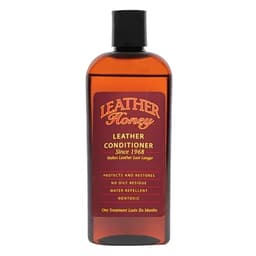
Against Leather Honey, the comparison is color stability versus depth of feed. Leather Honey is the better choice on a mid or dark brown bag you want fed deeply and rarely; Bick 4 is the better choice on anything pale, and on any bag where you want it to look the same next year as it does today. We have gone through this head-to-head in detail on our Leather Honey vs Bick 4 page, and there is a full Leather Honey review if that is the direction you are leaning.
Against Lexol, the asymmetry is in what each brand will put in writing. Lexol's standard conditioner page publishes no non-darkening claim at all — that claim attaches to a different product in its line — while Bickmore makes it directly on the Bick 4 page. If a published non-darkening claim is what you are buying, only one of the two sells it to you. Our Bick 4 vs Lexol comparison lays out the rest.
Against mink oil and neatsfoot, it is not close for a handbag. Those are heavy dressings built for boots and tack, they darken substantially, and over-application is the usual cause of the rancid, faintly fishy smell we cover on our smell-removal page. The reasoning is on our conditioner versus mink oil piece.
The verdict
Bick 4 is the right default for a specific and large group of bags: smooth, finished leather, especially anything light-colored, and any bag whose current appearance you want preserved rather than deepened. The non-darkening claim is made by the manufacturer on its own product page, the wax-free formulation explains why it can make that claim, and the brand is unusually clear about the four leathers to keep it away from.
It is the wrong product for suede, rough-out, napped and distressed hide, it does not waterproof, and it conditions more lightly than an oil-rich dressing — so a badly neglected, stiffened bag will take more passes to recover with Bick 4 than with something heavier. Priced where it is, the sensible answer for most people who own more than one bag is to keep both: this for the pale and finished ones, an oil-rich conditioner for the dark ones. Our care starter kit is the shortest list that covers both cases, and the conditioner roundup ranks the field.