Briefcase or work tote?
This is the decision the category obscures, and it matters more than the leather grade.
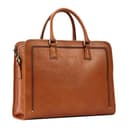
A real briefcase has rigid or semi-rigid sides, a flat reinforced base and, in the better ones, a laptop compartment suspended so it does not touch that base. It stands up on its own beside a desk, it takes a knock without the machine feeling it, and it reads as formal. The Banuce here is the only pick that genuinely qualifies. The cost is weight and money: a structured case uses several times the hide of a soft tote.
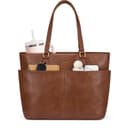
A work tote is open or lightly closed, soft or semi-soft, and loaded from the top. It is faster to use, lighter, more forgiving about an odd-shaped day, and it does not announce itself in a casual office. What it gives up is protection and formality.
The honest test is your dress code and your commute. Client-facing days in a conservative field push toward the briefcase; almost everything else is better served by a structured tote. Our briefcase versus messenger comparison works through the same trade in a different pair of shapes.
What we ranked on
Laptop fit first, stated only where the listing states it. A work bag that does not properly hold your machine is decoration, and “fits a laptop” without a size is not a specification.
Then structure, because it is what separates a bag that protects from a bag that merely contains. Then grade, written out as published — full-grain, top-grain, genuine leather, or synthetic, with nothing vague promoted into something better.
Then the shoulder question.A women’s work bag is usually carried on the shoulder rather than by the handle, so strap width and drop matter more here than they do in the men’s equivalent. A thin strap under a loaded bag is the complaint we would expect to hear first.
Why the price range is so wide
The picks below span from a budget synthetic to a full-grain Italian-leather case, and the gap is not arbitrary. Two things drive it: the amount and thickness of the hide, since leather is bought by the square foot and a structured case uses several times what a soft tote does; and the internal construction, since a padded, suspended laptop compartment with reinforced edges is meaningfully more work to build than a slot.
What does not drive quality is the number of pockets or the presence of a cup holder. Those are cheap to add and loud in a product title, which is exactly why they are worth discounting when you compare two bags at the same price. Our guide to leather pricing breaks the rest of it down.
Which one to buy
The Banuce is the pick if you want an actual briefcase: Italian full-grain, structured, cut as a case rather than a tote with ambitions. It is by a distance the most expensive bag here and the only one that will still look right in a decade.
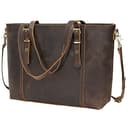
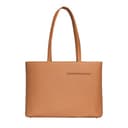
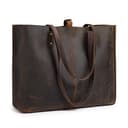
For most people, though, the TIDING full-grain work tote is the better buy — the same top grade, a shape that works as a handbag on the way in and a work bag at the desk, and enough structure to hold form loaded. The Raymaple is the one to take if a 15.6-inch laptop is the main cargo, because it is built around the machine rather than accommodating it. The S-ZONE is the value pick in real hide, soft rather than structured. And the LOVEVOOK is the cheapest sensible option if you have decided features matter more than material — it is a coated synthetic, and it will eventually peel.
Making a work bag last
Work bags fail at the base corners, from being set down on hard floors, and at the strap or handle attachments, from carrying everything. Keep the bag off wet ground, empty it rather than storing it loaded, and condition it once or twice a year with a thin coat — handles and corners first, since handling dries those fastest. Our storage guide covers the seasonal mistakes, and the troubleshooting page covers what to do when something has already gone wrong.
On the Italian leather claim
Two picks here state Italian full-grain leather, and that phrase deserves unpacking before you pay for it. Our guide to what Italian leather means explains what the claim covers, what the Tuscan tanning consortium certifies, and what we can and cannot verify from a marketplace listing.
If you are shopping for a man instead
The men’s side of this category is far better served, which is the whole reason this page exists — and the shapes and proportions are genuinely different rather than the same bags in a different photo. Our men’s leather briefcase roundup is the counterpart list, ranked on how formal each bag reads before anything else.