The three finishes sold as “vintage”
They are not interchangeable, and they age in genuinely different ways.
Crazy horse
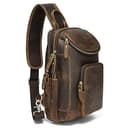
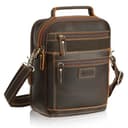
A waxed full-grain or top-grain leather where the wax sits in the top layer of the hide. Rub it and the wax moves, so the color lightens where it is stressed and darkens where oils build up. That is the effect people are actually buying — a bag that records how you use it. The Le’aokuu chest sling is the clearest example here, and its listing says outright that the scuffing is the intent rather than a defect.
Vegetable-tanned and left plain
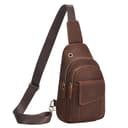
No heavy pigment, no wax, just tanned hide. It starts pale and goes through honey to a deep brown over a year or two of sunlight and handling. The SUIKIHUM sits closest to this. Its matte mid-brown has already moved some way along that path, so you are joining the change part way through rather than watching it from pale — the trade is that it hides an early mark far better than a bare pale hide would. Our vegetable versus chrome tanning guide explains why the tannage decides this more than the brand does.
Antiqued / printed “retro”
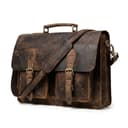
A darker glaze applied over the surface to fake the tonal variation of an old bag. On full-grain it is cosmetic and harmless — the cuero retro messenger is this, over genuinely full-grain hide. On a corrected or coated surface it is the whole product, and it will wear off rather than wear in.
How to tell a vintage finish from a fake one
The listing usually gives it away before you get anywhere near the bag. Look for the grade stated in words — “full grain,” “top grain,” “crazy horse leather” — not just a color name like “vintage brown.” If the only appearance of the word vintage is in the title and the material field says PU, faux or vegan leather, you are looking at a print. Our guide to spotting fake leather covers the wording sellers use when they want to imply hide without claiming it.
In the photos, look at the edges and the strap anchors. Real distressing is uneven — heavier where a hand would rest, lighter in the middle of a panel. A printed antique effect is suspiciously regular, and it stops dead at a seam because it was applied to a flat sheet before the bag was cut.
What a vintage finish is actually good at
It hides the first year. A plain black crossbody shows every scuff as a gray mark; a distressed brown one absorbs the same scuff into a surface that was already varied. If you are hard on bags, or you want to stop noticing small damage, that is a real practical benefit rather than a styling preference.
It also ages honestly. Because these finishes are all built on grades that keep the hide’s outer surface, they develop the darkening and sheen we describe in our patina guide. A bag that already looks a bit worn and then keeps improving is a much easier ownership experience than a pristine bag you are afraid to use.
What it is not good at
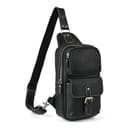
Formality. None of these read as smart. A distressed brown sling next to a suit looks like you brought your weekend with you, and no amount of conditioning fixes that. If the bag has to survive an office, the Polare is the one on this list that will — full-grain, Italian, and deliberately not distressed.
Consistency, too. Waxed and vegetable-tanned hides vary between batches and between panels of the same bag, so the item you receive will not look exactly like the photograph. That is inherent to the material rather than a seller cutting corners, but it does mean this is a poor category to buy in if you have a precise shade in mind.
Which one to buy
The LANNSYNE is the pick for most people: full-grain, sling-shaped so it carries on the chest or the back, and a vintage finish that swallows the first scuffs instead of displaying them. It is the whole proposition of this category done properly, and it is not expensive for the grade.
Buy the Le’aokuu if you want the most obvious distressing and you are using the bag for travel and weekends rather than work. Buy the SUIKIHUM if you want to watch the change happen — full-grain in a matte brown deepens with handling rather than wearing thin, which is the most satisfying version of this to own, and it is the cheapest full-grain bag we have found in the shape. The cuero is for anyone who wants the aesthetic at messenger size with a laptop inside, and the Polare is the sensible exit if you have read this far and decided you like full-grain but not the worn look.
If you want the same finishes in a bag that swallows a laptop and a folder rather than a phone and a wallet, our vintage leather tote roundup applies the same grade test to the tote shape.
Keeping the finish
Distressed and waxed leathers need less product than a plain finished bag, not more. Over-conditioning a crazy-horse hide floods the wax and flattens exactly the tonal variation you paid for — the bag goes uniformly dark and stops moving. Wipe dust off, let the wax redistribute with handling, and condition sparingly once or twice a year at most. Our conditioning guide covers how little to use, and our conditioner roundup flags which products darken light leather.