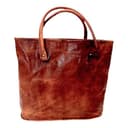
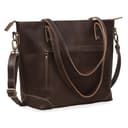
How we ranked them
Four criteria, applied in this order. They are weighted toward things a seller can be held to, because in this sub-category the adjectives are close to worthless and the published numbers are the only claims with consequences attached.
1. The grade claim, read at its lowest
Full-grain, top-grain and genuine leather are three different products, and only the first two are compliments. Where a listing uses one term in its title and a better one in its bullets, our spec tables record the weaker of the two — every time, without exception. That single rule reshuffled this page: two bags whose bullets claim full-grain are recorded here as genuine leather, and they rank below the one bag that says full-grain consistently everywhere. If the distinction is new to you, our guide to what “genuine leather” really means is the fastest way to stop being sold to.
2. Whether the finish is in the leather or on it
A vintage look produced by wax, oil or tannage lives inside the hide and gets better as it is handled. A vintage look produced by pigment sprayed over corrected grain sits on top, and layers wear through at corners rather than blending in. No listing announces which one it has sold you, but the language is a reliable tell: sellers who bought the expensive version describe the process, and sellers who did not describe the mood.
3. What closes, and what carries
This is where a tote differs from every other bag shape on this site. The classic tote is open-topped and carried by two short handles, which is wonderful for loading and poor for security and for rain. A zip top or a removable shoulder strap changes what the bag can be used for far more than an extra inch of capacity does, so both count heavily here.
4. Published numbers, and honest cons
A seller who publishes exterior dimensions and a weight has given you something you can complain about if it turns out to be wrong. Four of these six publish both. Every pick carries at least two real cons, and on this page several of those cons are drawn from the seller’s own listing — the smell warning on the Firu, the creasing warning on the befen. A seller who volunteers a drawback is telling you something useful about the rest of the listing too.
Why so many vintage tote listings contradict themselves
It is worth understanding the mechanism, because once you see it you will spot it everywhere. An Amazon title is a keyword field, not a description. Sellers write it to match what buyers type, and buyers type “genuine leather.” The feature bullets are written to sell, and the word that sells is “full-grain.” Neither field is checked against the other, so a single listing routinely carries both claims a paragraph apart.
You cannot resolve that from a photograph, and we do not pretend to. What you can do is treat the disagreement itself as information. A seller who genuinely bought full-grain hide says so consistently, in the title, in every bullet and usually in the product name, because it is the most expensive thing about the bag and there is no reason to be shy about it. The TIDING pick above does exactly that, which is why it holds the full-grain award on a page where two other bags also use the phrase.
The same logic applies to material claims that are not about grade at all. “Vegan leather,” “PU leather” and “leather look” all mean a coating on fabric, and the FTC guides in our sources require that to be disclosed rather than implied. Our comparison of leather and vegan leather explains when the synthetic is the better buy — sometimes it genuinely is — and our guide to spotting fake leather covers the physical checks worth running while the return window is open.
Waxed, distressed, vegetable-tanned: three different bags
The word vintage covers at least three finishes that behave nothing alike. Choosing between them matters more than choosing between brands.
Waxed pull-up
Hide finished with wax or oil suspended in the surface. Bend it and the wax moves, so the fold lightens; rub the light patch and it darkens back. That is why a waxed bag records where it has been handled, and why the befen listing tells you outright that creases and marks are expected rather than defects. It is the most dramatic ager here and the least forgiving choice for anyone who wants a bag to stay smooth.
Distressed
An uneven, deliberately mottled dye, usually on a thicker hide. Buffalo takes it especially well because the grain is coarse to begin with, which is what the KomalC pick is doing. A distressed finish is the practical choice rather than the romantic one: it absorbs the first year of scuffs entirely, because the surface was never uniform to start with.
Vegetable-tanned and undyed
Tanned with plant tannins rather than chromium salts, and in the Firu’s case colored by oil and sunlight instead of pigment. It starts pale, darkens considerably over the first year, and no two bags come out the same shade — which is exactly why that listing warns you about variation and about the smell. Our tannage guide sets out the trade-offs, and our note on how patina actually forms explains why a sealed finish will never do this no matter how long you keep it.
The open top is the tote’s real weakness
A classic tote has no lid. That is the shape’s great virtue when you are loading a laptop, a folder and lunch in one motion, and its great flaw everywhere else. On a crowded train an open tote is the least secure bag you can carry. In rain, the contents get wet. Set it down at an angle and it empties itself.
Two picks here answer that directly: the befen zips shut across the top, and the Creative Leather Art tote has both a zip and a removable crossbody strap, which is the combination that turns a tote into something you can wear through a city rather than carry across a car park. The KomalC, at the other extreme, is a large open shopper and makes no claim otherwise. If closure is what you are weighing, our roundup of leather totes with a zipper shortlists the bags that close fully, and our tote versus shoulder bag comparison is the wider version of this argument.
Weight, handle drop and the one-shoulder problem
Leather is heavy, and a tote hangs all of it on one shoulder. The bags here that publish a weight run from about 1.4 to 1.9 pounds empty, which is genuinely light for the shape — a structured full-grain work tote can be closer to three. Load one with a laptop, a charger, a water bottle and a notebook and you are carrying eight to ten pounds on one side of your body for the length of your commute.
Handle drop decides whether that is tolerable. Roughly eleven to thirteen inches clears a coat and sits the bag under your arm; a short drop means the bag rides in your hand, which is fine for ten minutes and miserable for forty. The befen publishes an 11.5-inch drop and the Creative Leather Art adds a full shoulder strap. If your walk is long enough that this paragraph worries you, read our tote versus backpack comparison before you buy anything — two straps halve the per-shoulder load, and no amount of good leather fixes the physics.
Which one to buy
The Morriloom is the answer for most people, and it wins on features rather than on romance. It is the only bag here with a padded, fleece-lined 15.6-inch laptop sleeve and a hidden luggage trolley strap — two things real-leather totes almost never have, and the reason our travel tote roundup ends up recommending a synthetic for the airport. Buy it knowing the listing argues with itself about grade and about weight, and that we recorded the cautious answer to both.
Take the TIDING if the grade is the point. It is the one bag on this page that says full-grain and keeps saying it, it is built as a work tote rather than a fashion one, and it sits at the top of this price range for exactly that reason. Everything else in that tier is on our full-grain tote page.
Take the befen if you want the bag to visibly change. Waxed cowhide is the most expressive finish here, it zips shut, it is light, and the seller is honest enough to warn you that it will crease. Take the KomalC if capacity is what you are short of — 18.5 inches across in distressed buffalo, with almost no organization and no laptop protection, which is a fair trade for a market-and-books bag but a poor one for a commute. Our large tote roundup covers the rest of that end of the range.
Take the Firu if you want the most character per dollar and can accept that what arrives will be a slightly different shade from the photograph and will smell of tannery for a week. And take the Creative Leather Art tote if you want a vintage tote that closes and can be worn crossbody, or if you are shopping for a man — it is the only pick here sold to both, and the wider selection is on our men’s leather tote page. If your budget is firm rather than flexible, our under-$100 tote roundup covers the same bracket without the vintage constraint.
Keeping a vintage finish looking vintage rather than tired
The mistake people make with these bags is treating them like a formal leather bag and trying to keep them even. The whole point of a waxed or vegetable-tanned finish is that it goes uneven, and every effort to correct that makes it worse.
Condition sparingly, and always all over.Twice a year is plenty for a bag in regular use. Spot-treating a scuff on a pull-up finish leaves a permanent dark halo, because conditioner darkens whatever it touches. Do the whole panel or leave it alone — the method is in our conditioning guide.
Let scratches settle before you do anything. On waxed leather most surface marks can be worked out with a thumb and a little warmth, and many disappear on their own within a week of normal handling. Reaching for a product first is how a light scratch becomes a dark patch.
Stuff it and stand it up.A soft vintage tote left empty on its side creases in the wrong places, and those creases are permanent in a way that handling marks are not. Fill it loosely with paper, keep it upright, and keep it out of direct sun — a vegetable-tanned bag will tan unevenly on a windowsill exactly as skin does. Our storage guide has the full routine, and our note on how long leather bags actually last sets out what is reasonable to expect at each price.
The two questions this page raises most often
Two follow-ups come up constantly on a page like this. The first is what a vintage finish actually is, and our guide to distressed leather separates the three mechanisms that produce a real one from the sprayed-on effect that imitates it. The second concerns the Firu tote, the only goat-hide bag we list and the lightest full-size tote here by a wide margin: our goat leather versus cowhide guide explains why a thin hide weighs so little and what you give up for it.