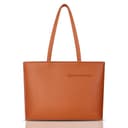
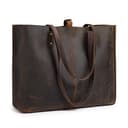
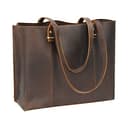
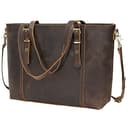
How we judged capacity
Three things decide whether a tote is genuinely large, and only one of them is the number in the title.
Base footprint.A tote’s usable volume is set mostly by how wide and deep its base is, because that is what determines whether a laptop, a lunch box and a bottle can sit side by side rather than being wedged in at angles. A tall, narrow tote with a big stated height is often less useful than a shorter one with a generous base.
Opening width. A large bag with a narrow opening is a frustrating bag. If the top gathers sharply or a magnetic closure pulls the middle together, the practical capacity is much smaller than the internal volume suggests.
Handle drop. The most common regret with a large tote bought online is handles that will not clear a winter coat. A tote you can only hand-carry for five months of the year is a smaller bag than its dimensions claim.
Structured or soft at this size
Structure matters more the bigger a tote gets. A structured tote — the two TIDING picks here — keeps a rectangular shape whether it holds two things or twelve. It stands beside a desk, it protects what is inside, and a laptop is not pressed against your hip through the side panel.
A soft tote at this size collapses around whatever is in it. The IRAMY and S-ZONE picks are both in that camp, and it is a legitimate trade: they are lighter, far more forgiving about being overfilled, and cost less. What they do not do is look tidy half-empty or protect a laptop. If a machine is riding in a soft tote, a padded sleeve is not optional.
Our full-grain tote roundup goes deeper on the structure decision, and the laptop tote roundup covers the picks built specifically around a machine.
The weight problem, honestly
This is where we would rather talk you out of something than sell you a bag you resent. Leather is dense. A large structured leather tote starts around two and a half to three pounds empty, where a comparable nylon tote is closer to one. Load it with a 15-inch laptop, a charger, a water bottle and a notebook and you are carrying eight to ten pounds on a single shoulder for the length of a commute.
Two shoulders halve that, which is the entire argument for a backpack and the reason we say it on a tote page. If your commute is a walk rather than a car journey, buy the backpack and be happier. If your carry is bulky but light — fabric, folders, a change of clothes — a large tote is exactly right, and the weight objection does not apply.
Which to buy
The IRAMY is our overall pick: a genuinely large soft leather tote at a price that does not require justifying, in the simple shape that suits both a gym bag and a work day. The S-ZONE does much the same job for slightly less and is the value choice if capacity is all you are optimizing for.
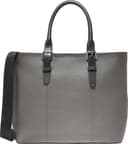
If the bag is going to carry a laptop most days, step up to one of the TIDING full-grain totes — the work tote for maximum capacity, the women’s cut for a more handbag-like shape that still holds its structure. And the Cole Haan is the brand-name option, where part of what you are buying is a consistent finish and a company with a returns process, which is a legitimate thing to want.
If you would rather the bag hid its wear than showed it, the distressed and waxed hides in our vintage leather tote roundup absorb scuffs in a way a smooth finish at this size never will — including an 18.5-inch buffalo shopper.
Making a large tote last
Big totes fail in two predictable places: the base, because they are set down on floors, and the handle attachments, because that is where the entire load goes. Both are worth a specific habit. Do not set the bag on wet ground, and do not store it loaded — hanging a full tote on a hook for months stretches the handle joins permanently.
Beyond that, condition it once or twice a year with a thin coat, paying particular attention to the handles, which dry fastest from handling. Our storage guide covers the off-season mistakes that quietly ruin good totes.
What a large tote weighs before you fill it
Capacity has a cost that listings rarely put a number on. A large leather tote can weigh over three pounds empty, and on one shoulder that is the difference between a bag you reach for and one you leave at home. Our leather bag weight guide collects every published figure we have and explains why grade, thickness and depth account for nearly all of the spread.
Capacity is one way to shop this hub and the job is another. Our totes for teachers page filters the same field on whether letter-size paper stands up inside the bag, and on which finishes survive a classroom.