What matters in a college bag specifically
Capacity for books, not just a laptop.Office backpacks are optimized around one flat machine. A college bag has to take that plus two or three textbooks, a notebook and a bottle, and textbooks are heavy and awkward. Judge the main compartment’s depth, not the laptop sleeve.
Weight, because you carry it all day. This is where leather costs you. A full-grain backpack can be three to four pounds empty against roughly one and a half for a technical pack. Add six pounds of books and the difference is real. If you walk a large campus, weigh this seriously.
A base that survives floors.College bags get set down constantly on concrete, tile and wet ground. Leather handles that far better than nylon — it abrades rather than tearing — but the base is still where wear appears first, so a reinforced base earns its keep.
Straps you can actually adjust. A heavy pack on thin, unpadded leather straps is genuinely unpleasant. Wide straps matter more here than in any other use case on this site.
Leather or canvas for four years?
We would be doing you a disservice not to put this plainly. If your campus is wet, if you walk a long way between buildings, or if the bag is going to live on floors and get treated roughly, waxed canvas with leather reinforcement is the more sensible material. It is lighter, it sheds water, it costs less, and it can be patched with a needle and thread.
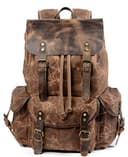
Leather wins if you want a bag that outlives college and goes on to a first job, if you like the idea of it aging rather than fraying, and if your daily walk is short enough that the weight is not a factor. That is why the WUDON waxed-canvas-and-leather pick is on this list — pretending full leather is right for everyone would be dishonest. Our leather versus canvas comparison works through the whole trade.
Which one to buy
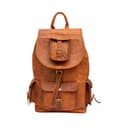
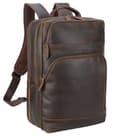
The TWARA is our overall pick and the one that makes sense of this page: it is full-grain, it states a 17-inch laptop fit, it publishes its dimensions, and it costs roughly half what the branded leather backpacks do. At a student budget that combination is unusual enough to lead with. The trade is that finish consistency is less predictable than an established maker’s, and the hardware is the part we would expect to complain first. It is also one of six picks in our under-$100 leather backpack roundup, if you want to see it measured against the rest of that budget.
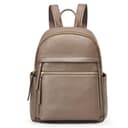
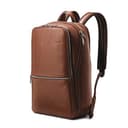
The WUDON is the answer if you are somewhere genuinely wet, and it is the lightest bag here by a clear margin. The Kattee soft daypack is the pick if your carry is a laptop and a notebook rather than a stack of textbooks — it is smaller and much lighter than the rest. The Samsonite slim is the brand-name option with a warranty process, and the Masa Kawa is the step-up in real leather for anyone treating this as a bag that will outlast the degree.
Making it survive four years
Three habits do almost all of the work, and none costs anything.
Do not overload it. Leather stretches under sustained weight and does not fully spring back. A pack routinely stuffed past its shape loses that shape permanently, and the zip line is where the strain shows first as the teeth start to separate.
Do not dry it with heat. A soaked bag on a radiator is how a good leather backpack becomes a stiff, cracked one. Blot it, stuff it lightly to hold its shape, and let it dry at room temperature over a day or two, then condition it once it is fully dry. Our troubleshooting guide covers water marks and the musty smell that follows a damp bag.
Condition it twice a year.Ten minutes at the start of each semester, a thin coat, corners and straps first. That is the difference between a bag that looks good at graduation and one that looks tired by sophomore year — the conditioning guide covers the amounts, which are smaller than most people apply.
The other campus bag buyer
A teacher carries a similar load to a student and judges it differently: the bag has to look right in front of a class, survive being set down on a hundred floors, and take marking home. Our leather backpacks for teachers roundup works through that version of the problem, and it is the page to send a parent who is shopping for one.
If a tote suits your campus better than two straps, our leather totes for school and college pageapplies the same three filters — a stated laptop fit, a closure and a published weight — to the other shape.