How we ranked them
Four criteria, applied in this order. They are deliberately weighted toward things a listing can be held to, because at this price the marketing language is close to worthless and the published numbers are the only thing with consequences attached.
1. The grade, exactly as stated
“Full-grain,” “top-grain” and “genuine leather” are three different products, and only the first two tell you anything flattering. We record whichever term the listing uses and we never promote a vague claim into a specific one. Where a listing gives two different answers, the spec table shows the lower one. If the difference is new to you, our guide to what “genuine leather” actually means is the fastest way to stop being sold to.
2. Published, checkable numbers
A seller who publishes exterior dimensions and a weight has given you something you can complain about if it is wrong. A seller who writes “large capacity” has given you nothing. Two of the six picks here publish both dimensions and a weight, which at this price is genuinely unusual and is a large part of why they rank where they do.
3. What happens to the laptop
A stated laptop size is one of the more reliable claims in any bag listing, because getting it wrong generates returns. What is far less reliable is whether the sleeve is padded and whether it is suspended off the base of the bag. Setting a pack down hard transmits that impact straight into the machine when the compartment bottoms out.
4. Honest cons, on every pick
Every bag on this page has at least two, and they are not decorative. At this price the compromises are real, and knowing which one you are accepting is most of what makes a cheap bag a good buy rather than a regret.
What $100 actually buys in a backpack
Less than it buys in a tote, and that gap is worth understanding before you judge anything here harshly. A tote is a simple object — two panels, a base, handles. A backpack is a structured one, with a padded back panel, padded straps, webbing, buckles, a suspended laptop compartment and several zips. All of that costs money before a single square foot of hide is cut, which is why the same budget stretches to full-grain in our under-$100 tote roundup and only just reaches it here.
What you can reasonably expect under $100: real hide rather than a coating, a stated laptop size, padded straps, and a bag that will look better in two years than the synthetic sitting next to it on the shelf.
What you should not expect: solid rather than plated hardware, burnished edges, a lining that is anything other than polyester, an established brand with a repair process, or consistent color between one unit and the next. The TIDING and LANNSYNE packs on our full-grain backpack page sit above this line, and the extra money buys precisely those things rather than a better-looking bag.
Why a backpack is the hardest shape to buy cheap
The strap anchors
Four small points carry the entire loaded weight of the bag, all day, every day. This is where budget leather backpacks fail, and they fail there long before the panels wear out. Look for wide straps that are stitched into a reinforced patch rather than riveted straight through a single layer — and accept that at this price, no listing will describe that clearly enough to be sure.
The back panel
The only part of any bag pressed against a warm, damp back for hours. Salt draws the oils out of hide and leaves it stiff, and a heavily sealed cheap finish can crack there first. It is also the part nobody ever conditions, because it is the part nobody ever looks at. One pick here answers this with a breathable mesh panel, which is a smarter fix than more leather.
The hardware
Zips and buckles are where a bag in this bracket saves money most invisibly. Nothing on this page publishes a zip brand, so we do not pretend to know. What we will say plainly is that on a sub-$100 leather pack, the hardware is the part we would expect to give out first — well before the leather does.
How to read a sub-$100 leather listing
Three habits will save you most of the money you might otherwise waste in this bracket.
Read the bullets, not the title.Titles are keyword fields. The feature bullets are where the material is described in detail, and where “PU leather,” “vegan leather” or “leather trim” tends to appear. If the two disagree, believe the less flattering one — that is exactly the call we made on the DEKVIO pick above.
Treat vague size language as an absence of information.“Large capacity” is not a measurement. A published set of exterior dimensions is, and so is a liter figure. Where a listing gives you neither, assume the bag is smaller than the photograph suggests.
Check whether the grade claim is specific.A seller who has genuinely bought full-grain hide will say so repeatedly, because it is the most expensive thing about the bag. A seller writing “high-quality genuine leather material” is describing nothing at all. Our guide to spotting fake leather covers the physical checks to run once the bag arrives, and the return window is the right time to run them.
Business pack, rucksack, or backpack purse?
Three silhouettes share this price bracket and they suit genuinely different lives.
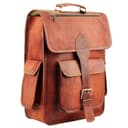
A business pack is flat-backed and zip-opening with a dedicated laptop section. It is the fastest to get into, it looks appropriate in an office, and it is the shape to buy if you open the bag ten times a day. The Yevabo is this shape.
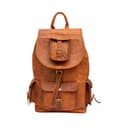
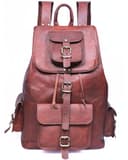
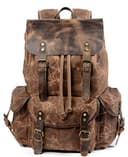
A rucksack is deeper and rounder, usually closing with a drawstring under a buckled flap. It carries an awkward, uneven load far better because the volume is not flat, and it looks relaxed rather than corporate. The trade-off is access: getting to the bottom of a rucksack in a hurry is genuinely annoying. The HULSH and the DEKVIO are this shape.
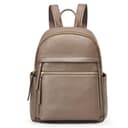
A backpack purse is a small, soft daypack sized for a phone, a wallet and a water bottle rather than a laptop. It is also the sub-category most thoroughly dominated by coated synthetics, which is why we keep a separate page for backpack purses that sorts the real hide from the rest.
Which one to buy
The HULSH is the answer for most people. It is the only pick here that names a grade above “genuine,” names its tannage, and publishes both dimensions and a weight — three pieces of information that most sellers in this bracket decline to provide. Buy it as a 15-inch bag rather than the 17-inch bag its own bullet claims, and buy it knowing a vegetable-tanned finish will darken noticeably in the first year. If that sounds like damage rather than a feature, our tannage guide explains which one you actually want.
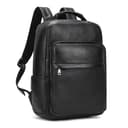
Take the Yevabo if the laptop is the whole point. It is the cheapest real hide on this page, it publishes a weight, and the mesh back panel is a comfort feature nothing else here offers. You are buying a plain black business shape with no character to develop — that is the trade.
Take the TWARA if you want full-grain and a big laptop and you are willing to sit at the top of this budget. Take the DEKVIO if volume is what you are short of, and read its grade con before you do. Take the Kattee if you want a soft, small everyday bag in real leather rather than a work pack.
And take the WUDON if, having read all of the above, you would rather have a material that is honestly excellent at this price than a leather that is merely acceptable. Waxed canvas with leather trim is not a compromise so much as a different answer — lighter, more weather-resistant, and covered properly in our leather versus canvas comparison.
Making a cheap leather backpack last
A budget pack rewards maintenance more than an expensive one does, because the finish is thinner and there is less margin for neglect. Three habits do almost all of the work.
Condition the straps and the back panel first.That order is deliberate and it is the opposite of what most people do. Those are the parts that flex constantly and take sweat, so they are the parts that dry, stiffen and eventually crack. Twice a year, thinly, is enough — the routine is in our conditioning guide.
Never hang it loaded by one strap. This is the single fastest way to tear a cheap anchor point, and it is entirely avoidable.
Empty it before it dries. A damp pack left packed holds moisture against the back panel and the base, which is how mildew starts. Open it, empty it, and let it dry away from a radiator.
Do that much and a pack from this bracket has a realistic shot at five or more years of daily use, which is a better cost-per-year than most nylon bags manage. Our note on how long leather bags actually last sets out what is reasonable to expect at each price, and where the money genuinely buys extra years.