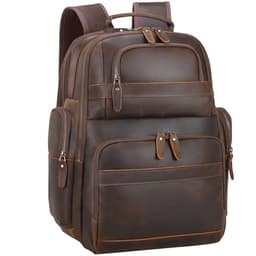
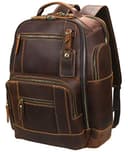
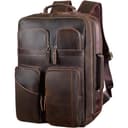
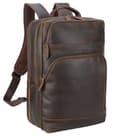
What full-grain actually changes in a backpack
The strap anchors
This is where leather backpacks die. Every ounce in the bag pulls on four small points where the straps meet the body, all day, every day. Full-grain keeps the hide’s densest fiber structure intact, so it resists that tension in a way a split or corrected layer does not. It is the single most practical reason to buy the grade in this shape.
The back panel
The one part of any backpack exposed to sweat. Salt draws oils out of hide and leaves it stiff, and a sealed corrected-grain finish can eventually crack there. Full-grain absorbs and recovers, particularly if you condition it — which almost nobody does, because it is the part you never look at.
How it looks in three years
A full-grain pack darkens where your hands touch the top handle and where the straps rub, and evens out into something with obvious history. A coated pack looks new, then looks worn, then looks bad. Our patina guide covers what to expect and roughly when.
The weight problem, stated plainly
None of the listings here publish a weight, so we do not quote one. What is certain from the material is the direction: full-grain has not been split down, so it is thicker and heavier than the same bag in a lesser grade, and a large full-grain backpack is a genuinely substantial empty object.
The good news is that a backpack is the shape best equipped to carry that. Two padded straps over your center of gravity handle a load that would be miserable on one shoulder — which is exactly the argument in our briefcase versus backpack comparison. If the total weight still worries you, the Masa Kawa on this list is genuine leather rather than full-grain and is the honest lighter option; we have included it labeled as exactly that rather than pretending the grade question has only one answer.
Read the capacity claims carefully
Leather backpack listings are unusually vague about size, which is why two picks here stand out for the opposite reason. The LANNSYNE publishes a 24-liter capacity and the TWARA publishes exterior dimensions of 20 by 12 by 8 inches. Numbers like that are a small signal of seller confidence, because they can be checked and complained about.
Where a listing gives only a laptop size, take it at face value — a stated 15.6 or 17.3-inch fit is reliable because getting it wrong generates returns — and treat everything else as unknown. “Large capacity” is not a measurement.
Rucksack or business pack?
Two silhouettes dominate this category and they suit different lives.
A business pack is flat-backed, zip-opening, with a dedicated laptop compartment and organizer pockets. It looks appropriate in an office and it is fast to get into. The TIDING pair are this shape.
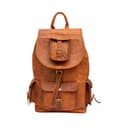
A rucksackis rounder, usually drawstring-and-flap, and carries an uneven load far better because the volume is deeper rather than flatter. It looks relaxed rather than corporate, and it is slower to access — a real irritation if you are in and out of the bag all day. The LANNSYNE is this shape and its listing is honest about the access trade-off.
Which one to buy
The TIDING 15.6-inch pack is the answer for most people buying a work bag: full-grain, a stated laptop fit, real organization, and the shape that suits an office. It is heavy and it is a premium price, and both of those are the cost of the grade rather than a markup.
The TWARA is the value pick and the one to consider hardest if the budget is finite — full-grain, a stated 17-inch fit and published dimensions at roughly half the branded price. Read its cons honestly: at that money the hardware is the part we would expect to fail first, and finish varies more between units. If the budget is firmer still, our under-$100 leather backpack picks cover the tier below this one, grade claims and all.
Take the LANNSYNE if you want a rucksack rather than a briefcase-with-straps and you value a published capacity figure. Take the 17.3-inch TIDING if you own a large machine and have discovered how few packs admit to fitting one — our 17-inch page covers the rest of that short list. And take the Masa Kawa if you have decided the weight matters more to you than the grade.
If you are shopping the marketplace rather than a specific grade, our Amazon leather backpack shortlist sets out the four listing checks that separate real hide from a coating — including the recognizable brand on that page whose own listing says faux leather.
Making one last a decade
One habit does most of the work: condition the shoulder straps and the back panel beforethe front panels. Those are the parts that flex and take sweat, and they are the parts everyone ignores because they are not the parts you look at. Twice a year, thinly, is enough — the routine and the amounts are in our conditioning guide.
Beyond that: do not leave it packed and damp, do not hang it by one strap when it is loaded, and expect it to be stiff for the first few weeks. Our breaking-in guide covers what softens on its own and the shortcuts that damage leather instead of speeding it up.
One honest gap in this category: full-grain listings are the least likely of any to say what is inside the bag. Every pick on this page states “multiple pockets” or “multiple compartments” and none of them counts. If you need to know the layout before you commit, our roundup of leather backpacks with lots of pockets includes only bags whose listings itemize what they hold — and explains why hide makes pockets expensive in the first place.