What Lexol actually publishes for this bottle
Separated from what the internet says about it. The maker’s own page for Lexol Leather Conditioner makes a short list of claims, and the directions are more specific than most brands bother with:
- It softens leather and helps prevent cracking, and “helps to prolong the life of your leather and protect your tack investment.”
- Apply it to a cloth, not to the bag.“Apply 1 or 2 sprays of Conditioner to a clean cloth or sponge and apply Conditioner over entire cleaned surface.”
- Wipe off the excess.“After a few minutes wipe off excess and buff with a clean cloth.”
- Use less than you think.“A little bit of Lexol goes a long way. Multiple light coats are better than one heavy coat.”
- Clean first if the leather is dirty, with Lexol Leather Cleaner named as the product for that step.
- Spot-test before each use.“Always test Lexol Leather Conditioner on a small, hidden area before each use.”
- Store it below 140°F to avoid weakening the container.
Now the absences, which are just as informative. The page for this conditioner publishes no pH figure, no statement about wax or silicone content, no non-darkening claim and no intervalbetween applications. Four things a reader would reasonably want to know, and the brand does not state any of them. We are not going to fill those gaps from memory — the spec table above says “Not published” where the brand is silent, which is this site’s standing rule.
The three bottles that share the name
This is the part that matters most, because it is where the internet gets Lexol wrong. There are three Lexol products in common circulation for leather goods, and each carries a different headline claim:
- Lexol Leather Conditioner— the bottle reviewed on this page. Softens, helps prevent cracking, light-coat application. No pH claim. No color claim.
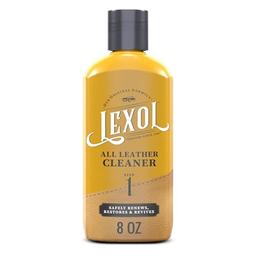
- Lexol Leather Cleaner — the bottle that carries the pH-balancedclaim: “pH balanced for safe cleaning,” with “no scum or residue left behind.” The pH-balanced reputation of “Lexol” attaches here, to the cleaner, not to the conditioner.
- Lexol Neatsfoot Conditioner— a genuinely different formula, built on neatsfoot oil, and the bottle that carries the “non-darkening for light leather”claim. If you have read that “Lexol does not darken leather,” this is the product that statement came from.
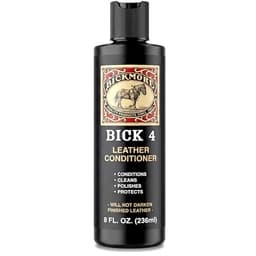
So the two claims most often attributed to the bottle on this page belong to its siblings. That is not a criticism of the product; it is a warning about buying it for a reason it does not actually claim. If a pale cream or natural tan bag is the thing you are treating and darkening is the risk you are trying to avoid, the standard Lexol conditioner is not the bottle whose maker has put that in writing — and the brand’s own instruction to spot-test before each use is a more cautious position than a flat no-darkening guarantee. On pale leather our Bick 4 review covers the one product in this category whose maker does publish a non-darkening claim for the bottle you are actually buying.
What the light-coat method is actually good at
“Multiple light coats are better than one heavy coat” is the most useful sentence Lexol publishes, and it describes a real difference in how a conditioner behaves rather than a marketing preference.
A conditioner works by getting oils and fats back into the fibre structure of a hide that has lost them. On a finishedleather — which is almost every handbag, because the surface is sealed with a pigment or clear coat — that absorption is slow and limited by the finish. Flood such a surface with product and most of it has nowhere to go: it sits on top, picks up dust, goes tacky, and the only way to remove it is more cleaning. Apply a little and wipe the excess, repeatedly, and you keep feeding the leather at the rate it can actually take.
That makes this bottle forgiving in the exact way beginners need, because over-application is the usual way people damage a bag with a care product rather than without one. Our guide to conditioning a leather bag sets out the routine, and the troubleshooting page covers what to do about a surface that has already gone sticky.
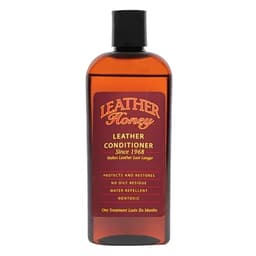
The flip side is equally honest: light coats are the wrong tool for leather that is already dry, stiff or starting to craze. That hide needs a deep, slow feed, which is the argument for an oil-rich conditioner instead — and our Leather Honey versus Lexol comparison is where that decision gets made on the two makers’ own published directions.
It is a tack-aisle product, and that cuts both ways
Lexol’s own page talks about protecting “your tack investment” and quotes a decades-old award from a horse journal. That is not a knock — equestrian leather care is the oldest and most demanding corner of this market, and a formula that survives there is dealing with hide that works harder than any handbag ever will.
It does mean the guidance is written for saddles, bridles and boots rather than for a finished calfskin handbag, and the two are not the same material problem. Tack is usually vegetable-tanned, undyed or lightly finished, and thirsty; a modern handbag is usually chrome-tanned with a sealed surface. The difference is explained in our guide to vegetable versus chrome tanning, and it is the reason a product can be excellent on a saddle and merely fine on a bag.
The practical upshot for a bag owner: the light-coat instruction is the part to follow religiously, the “soaks in deeply” language in this category is mostly about leather yours is not, and the spot-test is not optional on any coated or pale finish.
What it does not do
Four limits worth stating plainly, three of them from the brand’s own pages.
It is not a cleaner. The directions tell you to clean first with a separate product if the leather is dirty, which means the real entry cost is two bottles rather than one. Conditioning over grime drives the grime in. Our leather cleaner roundup covers that step, including the Lexol cleaner the maker names.
It is not waterproofing. No conditioner is. A conditioner replaces oils; a repellent adds a sacrificial barrier, and they are different jobs done in a different order. See how to waterproof a leather bag and the protector spray picks for the layer that actually does that.
It is not for suede or nubuck. Napped leather needs a dedicated napped-leather product; a liquid conditioner mats the nap and the change is not reversible. Our suede bag care guide is the right page for those bags.
It publishes no schedule.There is no stated interval between applications, so “how often” has no answer from the brand. Our position, argued on the conditioning guide, is to work on the leather’s schedule rather than the calendar: condition when the surface looks dull, feels dry or stops shedding a drop of water.
The verdict
Lexol Leather Conditioner is a sensible, inexpensive, widely available bottle for routine upkeep on a finished bag, and its own directions are the best argument for it: little and often, onto a cloth, excess wiped. That method is hard to get wrong, which on a bag you care about is worth more than a dramatic one-application transformation.
Buy it if you want a maintenance conditioner for a bag that is in good condition and you would rather do a little every couple of months than a lot once a year. Look elsewhere if darkening is the risk you are managing (the maker makes no non-darkening claim for this bottle), if the leather is already dry and stiff and needs a deep feed, or if you wanted the pH-balanced formula — that is the cleaner, and it is a separate purchase either way.
Three alternatives below, including the Lexol cleaner the brand’s own directions send you to first. For the wider field, our leather conditioner roundup ranks the whole category, and the care starter kit is the three-product shortcut if you are starting from nothing.