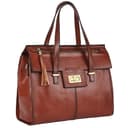
What “Italian leather” is, and what it is not
The reputation is real and it is old. Tuscany holds a dense cluster of long-established tanneries, and the best of them produce hide that a specialist can pick out by hand. The consortium we cite below describes the Tuscan leather district between the provinces of Florence and Pisa as the only Italian district producing high-quality vegetable-tanned leather, and lists 18 tanneries that have signed up to its standard since 1994.
Now the gap. A marketplace listing that says “Italian full-grain leather” is not telling you it came from one of those 18 houses. It is not telling you which tannery, which region, which tannage or which part of the hide. Italy tans an enormous volume of leather at every quality level, as does every other tanning country, and “Italian” on a bag is closer to “Italian styling” than to a protected designation of origin on a cheese. Our guide to what Italian leather actually means works the whole question through, including what the consortium’s mark looks like if you ever see one.
So what should you read instead? The grade. “Full-grain” describes which layer of the hide you are getting — the outer surface with its grain intact rather than sanded and re-coated — and it is the claim that actually predicts how the bag ages. All five bags here state it. If the distinction is new to you, our full-grain versus top-grain guide is the one to read first, and our patina guide explains what that grade gets you over five years.
One more useful distinction, because it causes more confusion than any other here: Italian is not the same as vegetable-tanned. The consortium certifies a tannage in a region, not a nationality. Plenty of Italian tanneries chrome-tan, which is not a demerit — it is how you get a supple, color-stable hide, and most bag leather on earth is chrome-tanned. None of these five listings states its tannage, so we do not state one. Our vegetable versus chrome tanning guide sets out the real differences without declaring a winner.
How we ranked five bags that all make the same claim
When the headline claim is identical across the shortlist, it stops being a ranking criterion. These four do the work instead.
1. What the listing publishes. This separates the five more sharply than anything else. The Polare RFID sling publishes a dimension, a weight, a strap range, a hardware brand and a warranty term. The other four publish no weight at all, and three publish no dimensions either. On a structured briefcase that absence is a real problem, which is covered below.
2. What it protects, and what it admits it does not. The Banuce briefcase states a 15.6-inch laptop fit. The Banuce convertible backpack states no laptop size whatsoever, and we flag that on its card rather than letting the shape imply one — it is a day bag. The two slings cap at a tablet; the purse is not a laptop bag and does not claim to be.
3. Then shape scarcity.Two of these bags exist in shapes this market barely serves: a women’s briefcase cut as an actual briefcase rather than a tote with a laptop slot, and a convertible backpack that names full-grain. That scarcity is a legitimate reason to pay more. It is not the same reason as the leather.
4. Then price against what you get. Not against the word. The two cheapest bags here publish the most and are the two we recommend to most readers, and we are aware that is also the less profitable recommendation.
The two-brand problem, and the price cliff inside it
Five bags, two brands, and the brands are not competing on the same axis at all.
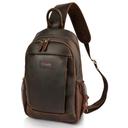
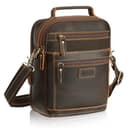
Polaresells slings, and sells them at the bottom of this range. Both of its bags here read as genuinely documented products: the RFID model states YKK zippers, reinforced stitching, a lockable main compartment, a hidden rear pocket, an internal RFID-blocking pocket, its dimensions, its 2 lb weight, a 35–50 inch strap range and a one-year warranty. That warranty is worth dwelling on: three listings out of the 90 we track state any warranty term, and this is one of them. The standard Polare sling is the plainer, lighter, business-leaning version of the same idea for less, and it publishes less.
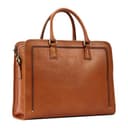
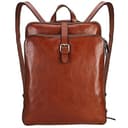
Banucesells structure, and charges two to three times as much for it. Its briefcase is the women’s work bag this category is genuinely short of, and our women’s briefcase roundup says the same thing in that shape’s own context. Its convertible backpack is the only women’s-cut leather backpack we track that names full-grain rather than settling for “genuine” — see our backpack purse page for the shape and our convertible backpack roundup for what the hinge costs mechanically. Its purse is the style-driven option, and the fringe detailing is a specific look rather than a neutral one.
What Banuce does notgive you is disclosure. No dimensions, no weights, no hardware spec, no warranty term, and in the backpack’s case no laptop size. Structured cases in full-grain hide are heavy by construction — that is physics, not a flaw — so the missing weight on a bag you will carry every day is the one gap we would most want closed. Our guide to how heavy a leather bag is gives you the comparison figures to work from in the meantime.
Pick by what you are actually buying
A travel or crowded-commute bag with a tablet:the Polare RFID sling. It is the most disclosed bag on the page and the only one here with any security feature — it is also the top pick on our anti-theft leather bags pillar, where it is the single bag in our whole registry whose listing states a lockable main compartment.
The cheapest honest route into this claim: the standard Polare sling. Business-casual shape, sits flat against the body, leaner capacity than it looks. Compared against the rest of its shape on our sling bag roundup.
A formal office and a 15-inch laptop: the Banuce briefcase, and budget for the weight. It is the priciest bag on this page and the only one cut as a real briefcase.
One bag for a commute and an evening:the Banuce convertible backpack — with the caveat on its card taken seriously. It states no laptop size, so do not buy it as a work pack.
A bag chosen for how it looks: the Banuce purse, which is the most style-driven thing here and makes no pretense otherwise.
A documented full-grain bag in a shape nobody here makes: drop the origin claim. Our full-grain leather bags pillar lists every bag we track that states the grade, across every shape and price, and several of them publish far more than the Banuce bags do.
What is missing from this category, counted
Three shapes make the claim nowhere in our registry, and the absences are more informative than another pick would have been.
No Italian-leather messenger bag.We track four messengers and two of them state full-grain — neither says Italian. If the messenger shape is what you want, our messenger bag roundup is the page, and the grade claim is available there.
No men’s Italian-leather briefcase.The one Italian briefcase we track is cut for women. The men’s cases that state full-grain are on our men’s briefcase roundup and our men’s bags under $100 page, which counts sixteen full-grain bags below that ceiling — more than above it.
No large Italian-leather work tote. The only tote-category pick here is a statement purse. The full-grain work totes we do track are on our full-grain tote roundup.
The claim nobody in this market makes
Worth closing on, because it puts the whole page in proportion. Not one of the 90 bag listings we track names a tannery, a country of tanning, or any audited standard.Five say “Italian” and name nothing further. The closest thing to real traceability we have found in this category came from a brand we do not list at all: as our Bellroy alternatives page records, that brand states on its own site that all of its leather comes from tanneries holding a gold rating from the Leather Working Group — a named grade plus an audited tannery standard. It is the only such claim we have seen, it costs more, and it is a fair illustration of what documentation is worth when somebody actually provides it.
None of which makes the five bags on this page a bad buy. Four of the five are reasonable-to-good purchases on their own merits, and the top two are among the better-documented listings in our registry. Just buy them for the grade, the shape and the specifications — and treat the word “Italian” as the free decoration it is.