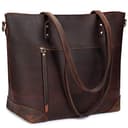
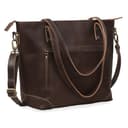
How we picked
One hard filter, applied before anything else: the listing has to describe the strap. A bag photographed with a strap but specified only as a “tote” does not qualify, because a strap that is not in the specification is a strap that can quietly vanish from the next production run. Three of the five picks state a strap that detaches (“detachable”, “removable”), one states an adjustable crossbody strap as the bag’s primary carry, and one — the Michael Kors — states top handles plus a shoulder strap without saying whether it comes off. We have kept it in the list and labelled it honestly rather than quietly promoting it to “crossbody”.
After that we ranked on what the rest of the bag gives you for the money: grade first, then closure, then published size. That is why a full-grain satchel with a stated crossbody strap outranks a larger bag whose own listing cannot decide which grade it is.
Detachable, removable, adjustable — what each word buys you
Three words, three different mechanisms, and it is worth separating them before you spend anything.
- Detachable or removablemeans the strap clips to a pair of D-rings or lobster clasps and comes off. This is the one that matters most, because the bag then works both ways — handles for the office, strap for the platform. It also makes the strap a replaceable part, which is a quiet durability advantage: a stretched or worn strap becomes a cheap swap instead of a dead bag.
- Adjustablemeans the length can be changed, usually with a slide buckle. Adjustable is necessary but not sufficient — a strap that adjusts between 30 and 40 inches is adjustable and still too short to cross most adult torsos.
- Fixed shoulder strap means a strap sewn or riveted in place. There is nothing wrong with it, but you own one carry position for the life of the bag, and on a tote a fixed strap sits in the same space as the top handles and tangles with them.
If a bag you otherwise love has D-rings and the wrong strap, that is a solvable problem: aftermarket leather and webbing straps in the 45 to 55 inch range are sold separately, and swapping one on is the cheapest upgrade in this whole category. Check the ring’s internal diameter against the clasp width first, and see our bag hardware guide for what a load-bearing anchor should look like.
Why weight matters more on a crossbody tote
A tote on your shoulder is carried by your shoulder, your upper arm and, if we are honest, a slight permanent hunch. Worn across the body, the whole load hangs from one narrow strap and transfers to the opposite hip, so the bag’s empty weight becomes the first thing you feel. The spread in our own registry is wide: the lightest tote that publishes a figure is 1.41 lb and the heaviest is 3.35 lb, a two-pound difference before anything goes in.
The S-ZONE is a stated 2.43 lb empty, which is a lot of bag on one strap and the reason we have labelled it for a commute rather than for all day — load it with a 15.6-inch laptop and a charger and you are carrying five or six pounds on a single line of leather. Our weight guide has the full published range, and our page on bag shoulder pain covers how to carry a load like that without paying for it later.
Where the strap meets the bag
Two failure points are worth checking in the listing photographs, because they are where crossbody totes actually fail. The first is the anchor: a D-ring riveted through a reinforced leather tab will carry a loaded bag for years, while a ring stitched to a single layer of thin lining will not. The second is the top edge either side of the strap. Hanging a loaded tote from two points pulls the mouth of a soft bag into a V, which means an open-top tote is more exposed worn crossbody than it was on your shoulder.
That is the strongest argument for pairing a crossbody strap with a closure. Two of the picks here state a top zip, and if you are going to wear a tote across your body in a crowd that is the combination to want — our zip-top tote roundup covers the full field of totes that close.
Should you buy a tote for crossbody carry at all?
Sometimes the honest answer is no. If hands-free carry on a commute is the main reason you want a strap, a bag designed around a single strap will do it better than a tote retrofitted with one: the body is shaped to sit against you rather than swing, and the anchors are engineered for the whole load. Our large crossbody roundup covers that side of the choice, and our crossbody versus tote comparison works the decision through properly.
Buy a tote with a crossbody strap when you genuinely need both carries in one bag — handles for a meeting, strap for the walk to the station, one bag by the door. That is a real requirement, and it is exactly the case the picks above serve.