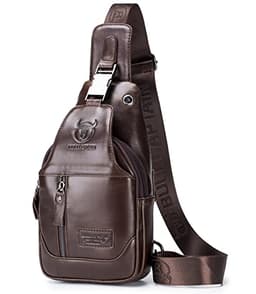
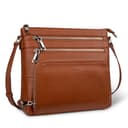
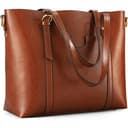
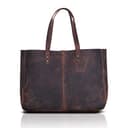
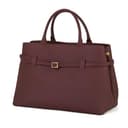
What each shape is actually good at
The crossbody wins on security and on staying put.Worn across the body the bag sits in front of your hip where you can see it and keep a hand on it, and nothing you do — stairs, a bike, a crowded train — makes it slide off. It also cannot be left behind, which sounds trivial until you count the number of bags lost in cafes. For travel days this is the whole argument, and it is why our travel crossbody roundup exists.
The tote wins on volume, on flat things and on access.A tote is the only one of the two shapes you can look down into while standing, which is a genuine daily advantage: paperwork, a laptop, a lunch box and a water bottle all go in and come out without taking the bag off. It is also the shape that scales — our largest pick is a published 18.5 inches across, which is a market bag, a work bag and a hand-luggage bag at once.
Each shape has one failure the other does not. A crossbody worn on the same side every day puts a narrow strap on one trapezius for hours; a tote asks you to hold your shoulder up to stop the handles sliding off, which is why people end up walking with one shoulder raised. Our guide to bag shoulder pain covers both patterns and what to do about them.
The decision table
- Phone, wallet, keys, charger, maybe a small tablet— crossbody. Lighter, hands-free, more secure, and you will carry it daily rather than leaving it at home.
- A laptop, a folder, a notebook or anything over about 11 inches wide— tote. This is not a preference; the crossbody cannot physically take it.
- A long commute standing up— crossbody, or a tote with a detachable crossbody strap. A loaded tote on one shoulder for forty minutes of standing is the worst case for both your shoulder and the bag’s handles.
- An office day with a desk— tote. The weight only sits on you between the car or station and the desk, and open-top access beats everything while you work.
- Travel, festivals, markets, cities you do not know— crossbody, zipped. See our small zipped crossbody picks.
- You genuinely need both— buy a tote with a detachable crossbody strap rather than two bags. Our crossbody-strap tote roundup is the whole field, and the DONNAIN below is the short version.
What the leather does to the decision
Material changes this comparison in a way it does not change for nylon bags. Leather is heavy — a leather tote is a meaningful object before you load it — so the weight argument above hits the tote harder in leather than in fabric. It also means a leather crossbody is the easier first leather bag to live with: less hide, less money, less weight, and it still gives you the hand and the patina that are the reason to buy leather at all. Our patina guide explains which finishes develop that character.
There is one structural difference worth knowing. A tote carries its load on two handles sewn to the top edge of the panels, so the stress is concentrated at four stitch blocks; a crossbody carries its load on one strap anchored to two rings at the sides. Both are fine when done properly, and both are where cheap bags fail first. Our hardware guide shows what to look for, and our strap and handle repair page covers the fix when it goes.
How much do you actually carry?
One exercise, worth five minutes before you spend anything. Empty your current bag onto a table, then put back only what you used in the last seven days. Most people find two things: the daily core is smaller than they thought, and there is exactly one large flat item — a laptop or a folder — that dictates the bag.
If that flat item only travels two days a week, the honest answer is a crossbody for the other three days rather than a bigger bag for all five. If it travels every day, buy the tote and treat the crossbody as the evening and weekend bag. Our size guide has the measurements of the things people actually carry, and our crossbody sizing page narrows the smaller shape down.
What about a shoulder bag or a backpack?
They are the two neighbouring answers and both are sometimes correct. A shoulder bag is a crossbody with a shorter strap and a bigger body — the middle ground, covered in our crossbody versus shoulder bag comparison. A backpack is the only shape that halves the load by using two straps, and for a heavy daily laptop carry it beats both bags here on comfort, which our tote versus backpack page says plainly even though it costs us the tote sale. If your load is heavy and your commute is long, read that one next.