Why a sealed finish, in plain terms
Leather finishes sit on a spectrum. At one end is aniline or unfinished hide: dye goes into the fibre and nothing much covers it, so the surface breathes, absorbs, marks easily and develops a patina. At the other end is pigmented or coated leather: a pigment-and-binder layer sits on the surface, which is why it resists water and rubbing, wipes with a damp cloth, and will look essentially the same in five years as it does today.
For a bag you want to love, the first end wins. For a bag that will meet sanitizer, coffee, a wiped-down table and the boot of a car, the second end wins and it is not close. Pebbled and structured finishes help too, for a duller reason: a textured surface hides the small marks a flat smooth panel displays. Our pebbled versus smooth guide covers that trade, and our saffiano page describes the most extreme version of it — a coated, cross-hatched calfskin that is the most wipeable leather in the whole category and will never patina.
What alcohol actually does, and what to do instead
Alcohol is a solvent and a desiccant at the same time. On a finished leather it softens and lifts the top coat, so repeated contact in one place — the handle, the spot your hand rests — takes the finish off unevenly and leaves a dull, slightly sticky patch. On an unfinished leather it strips the oils out of the fibre, which is the same damage a hot car does, except concentrated into a few square inches.
Two practical responses. First, wipe the bag with a damp cloth and a proper leather cleaner rather than with an alcohol wipe; it is slower and it is the difference between a bag that looks tired at five years and one that looks ruined at one. Second, condition the handle and the contact points on a schedule rather than when they look bad, because that is where the alcohol and the hand oils land. Our strap and handle page covers the repair end of that, and our page on leather and sweat explains the other chemistry a shift bag meets, which is salt rather than solvent.
The closure question
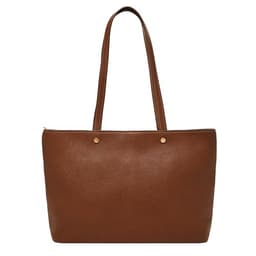
Three of the five picks state a zip closure, and on a shift bag that is worth more than any amount of leather grade. A bag that zips does not spill when it goes over in a locker, does not display its contents on a break-room table, and keeps the inside cleaner, which matters when the bag travels between a car, a staff room and home. Our zip-top tote roundup is the full field if none of these suits.
If you want to be able to wear the bag across your body on the walk in — a genuinely useful thing at the end of a night shift — look for a detachable strap rather than a shoulder strap, and read the drop measurement. Our crossbody-strap totes page explains the numbers.
Weight and size, with the numbers we have
Two of the five picks publish an empty weight: 1.76 lb for the Raymaple and 2.2 lb for the befen. Three publish dimensions. That is thin data, and it is the normal state of this category — where a listing does not publish a figure, our table says “Not published” rather than guessing.
On size, smaller is usually right here. A shift bag holds a phone, a wallet, a badge and lanyard, pens, snacks, a drink, lip balm, maybe a small pouch of the things you have learned to carry. It does not hold a laptop unless your week includes study days, and the two picks that do take a 15.6-inch machine are heavier and larger for exactly that reason. Shoes and scrubs travel better in a separate bag than in the one you carry your phone in. Our size guide has the measurements if you want to check a specific load, and our small totes are the next step down.
Where leather is the wrong answer
We would rather say this than sell a bag that disappoints. If your bag is going to be wiped with alcohol routinely, set down on surfaces that get cleaned, and occasionally rained on in a car park, a wipe-clean synthetic or a nylon tote will outlast any leather bag on this page and cost a fraction as much. That is the same conclusion our leather versus nylon comparison reaches for a rainy commute, and it holds here for the same reason: leather wins on how it looks and how it ages, not on resistance to chemistry.
Buy leather for this job if you want a bag that reads as grown-up, that you will still be carrying in five years, and that you are willing to clean properly instead of wiping with whatever is on the wall. Choose the sealed finish, choose the zip, and keep the alcohol off the handle.
If a backpack suits your commute better than a tote, our work backpack roundup applies the same logic to two straps, and our teachers’ backpack page is the closest sibling to this one in a different shape.