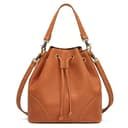
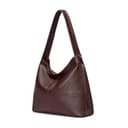
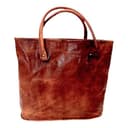
What BAGGU’s recycled leather actually is
This is the part worth getting right, because the phrase misleads in both directions and BAGGU itself is admirably precise about it.
Its Design and Materials page breaks the build into three named layers. “The leather layer is made entirely of reclaimed leather fibers.” Beneath that, “100% recycled polyester that comes from everyday consumer and commercial sources, transforming what would otherwise be discarded into a functional backing material.” On top, “a water-based polyurethane coating.” In total the brand states the material is 70% recycled leather — “a higher percentage than most recycled leather bags on the market.”
So it is not plastic pretending to be leather, and anyone calling it that is wrong. It genuinely contains hide. But it is not a layer of hideeither — it is ground leather fibre bonded to a fabric base and sealed under polyurethane, which is why no grade is named anywhere on the page. There is no grain to grade. That single structural fact explains everything downstream: there is no fibre network running through the thickness to flex and burnish, so the surface cannot patina, and there is no open grain to absorb a conditioner, which is precisely why the brand says not to use one. Our guide to leather types and grades sets out where real grades sit, and what full-grain actually means explains why the intact grain is the whole point.
What BAGGU is genuinely good at
A page like this is useless if it only criticizes, so here is the other side, and some of it the bags below cannot match.
It publishes its materials line by line.Three named layers and a percentage. Most of the marketplace listings we track will not tell you which layer of hide their bag is cut from, and several of the picks below name one grade in the title and a better one in the bullets. BAGGU’s disclosure is better than theirs, and that deserves saying.
Its care instructions are honest and simple.“Spot clean only… use a soft, clean cloth with water.” No upsell, no proprietary balm, and an explicit warning away from conditioner rather than a vague one. Compare that with the leather listings on this page, which mostly say nothing about care at all.
Its terms are published.A “one-year limited warranty against defects in materials and workmanship” which “does not cover general wear and tear”; returns within 30 days on full-price items in unworn condition; sale items final; a $4.95 restocking fee on most returns. That is more than any marketplace seller below publishes, and knowing the restocking fee in advance is the kind of thing a brand with nothing to hide tells you. It also states that as of Fall 2023 all its fabrics are made without PFAS.
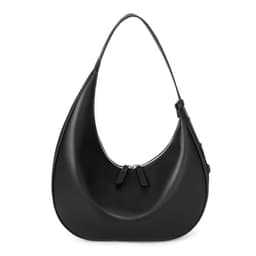
Its prices are not unreasonable for what it is.On the date we read its collection page, the Medium Recycled Leather Crescent listed at $180, the Small at $150, the Recycled Leather Shoulder Bag at $190 — described as having “a smooth, pebbled finish and metal hardware” and room for a 13 or 14-inch laptop — the Bowler at $190 and the Pochette at $90, several shown with sale prices beside them. That is designer-adjacent pricing for a bonded material, which is the thing to weigh; it is not a rip-off, it is a decision about what you are paying for.
Where the leather bags win, specifically
You can feed them. This is the headline difference. Every bag below takes a conditioner, which means a dry, tired bag in year four is a twenty-minute job rather than a replacement. Our conditioning guide is the ten-minute version and our conditioner picks cost less than the shipping on a new bag.
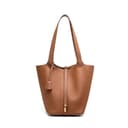
They improve.Full-grain creases, darkens and burnishes where your hand and hip touch it. One pick here states full-grain cleanly — the TOGO bucket bag — and three more claim a better grade in the body while saying “genuine leather” in the title, which we record as the lower claim. Our patina guide explains what actually happens and over what timescale.
They cost far less.The budget pick here is under a quarter of the Medium Recycled Leather Crescent’s list price, and the most expensive pick on this page is still well under it. Our bags under $100 page is the broader version of that point.
They can be repaired. A torn strap on hide is a cobbler job. A delaminated coated surface is not repairable by anyone, which is the quiet endgame of every bonded material. Our strap and handle repair guide covers what is actually fixable.
Where the leather bags lose, and you should know this
None of them is washable. Not one. If a bag in your house gets yoghurt in it twice a year, that is a real argument for the nylon BAGGU and we are not going to argue it away. Our page on whether you can wash a leather bag is blunt about this.
None of them closes properly. This is the weakest point of the whole category and it is worth stating as a count: of the six picks, not one listing states a zipper. The two bucket bags are drawstring or open; the Morriloom listing mentions no closure anywhere; the crescent and the large slouchy hobo do not describe one either. BAGGU’s own crescent states an interior zip pocket. If a closure matters to you, read our totes that genuinely zip shut instead of this page.
Most of them publish nothing.Three of these six publish no dimension, no weight and no pocket count. The Firu tote publishes 16 x 12 x 4 inches at 1.41 lb, and the TOGO publishes 8.9 x 7.7 x 12.2 inches — and that is the extent of the disclosure on this page. Where a listing is silent our table says “Not published” rather than guessing.
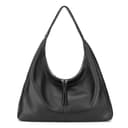
Two of them contradict themselves on grade. The befen crescent and the large slouchy hobo both name full-grain in the listing body and genuine leather in the title. Our rule everywhere is to record the lower claim, which is what the table shows. Our guide to what “genuine leather” is allowed to mean explains why that is not a small discrepancy.
Pick by which BAGGU you were looking at
The Crescent or Flat Crescent: the befen crescent hobo, which is the only bag we track that names the crescent cut. The befen large slouchy hobo if you found the medium crescent too small.
The Recycled Leather Shoulder Bag: nothing here matches its 13-14 inch laptop claim, so be clear-eyed. If the laptop was the point, read our laptop tote picks; if it was the pebbled finish and the hardware, the Morriloom two-strap is the closest at a fraction of the price.
The Bowler or a bucket shape:the TOGO full-grain bucket bag, which publishes its dimensions — rare in this shape — or the S-ZONE two-strap, which is the only bucket here with both a crossbody strap and a top handle stated. Our leather bucket bag roundup goes deeper on the shape alone.
The Pochette or a small zip pouch: none of these, honestly. They are all shoulder bags. Our small zippered crossbodies page is where that shape lives, and those bags do close.
The Standard or Big BAGGU reusable tote: buy the BAGGU. A folding ripstop shopping bag that lives in a pocket has no leather equivalent and should not have one.