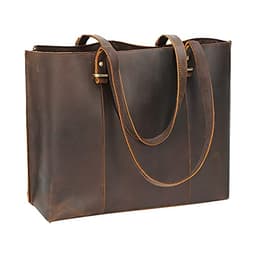
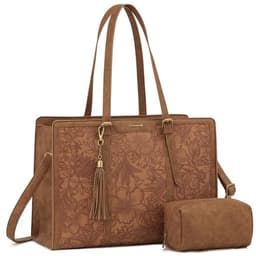
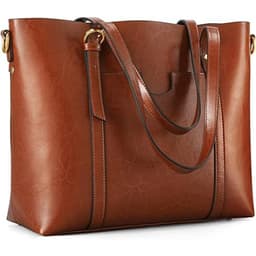
What top-grain buys you here
Top-grain is the second grade: the outermost layer of the hide with the surface sanded and sealed to remove blemishes. That is a real trade rather than a downgrade. You lose most of the patina potential, because the sealed surface stops oils moving through it, and you gain a consistent, low-maintenance finish that does not mark every time it touches a desk.
On a work bag, that trade is often the right one. A tote that goes on train seats, office floors and coffee-shop tables is going to collect marks, and a uniform sealed finish absorbs that far more gracefully than an uncorrected full-grain hide does in its first year. Our grade comparison sets out exactly what each one does over time, and our genuine-leather explainer covers the grade below this, which is what most totes at this price actually are.
The open top is the thing to know before you buy
The listing names no closure for the main compartment — its own feature bullet calls the interior “spacious open,” and the only zip it mentions is a pocket inside. So treat this as an open-top tote. That is how most leather totes are built, because a full-width zip on a soft bag is fiddly to make well, but it is worth knowing rather than discovering.
What it costs you: an open tote spills when it tips, exposes a laptop to rain running off a coat, and gapes at the top when it is full. If you have owned a work tote before and found yourself holding it closed on the train, that is the thing this bag will not fix — and our zip-top tote roundup lists only bags whose listings state a closure in words.
What the listing does state about structure is a reinforced interior base plate that keeps the bag standing upright on its own, with protective metal studs on the bottom. On a bag that spends its day on office floors and train seats, that is the more useful claim of the two.
What it leaves out
There is no padded laptop sleeve, and the listing does not claim one. The 15.6-inch fit is the main compartment, which means the machine sits in the bag with whatever else is in there. That is entirely usable — and it is how most leather totes work — but it needs a slip sleeve, which costs very little and is not optional in our view.
There is also no luggage strap and no cup holder, the two features that make synthetic work totes so convenient. If those matter more to you than the material, the LOVEVOOK in the alternatives below has all of them and is a PU bag, and we would rather say that plainly than let you find out after buying.
And it is a one-shoulder load. The listing publishes 1.76 lb empty, which is genuinely light for a leather tote of this size, but a laptop and a day’s paperwork on top of that still hangs off one shoulder for a whole commute. If your walk is long, our tote versus backpack comparison is worth reading before you commit.
Who should buy it
Someone who has decided the material matters. If you have been through one or two coated-synthetic work totes and watched the finish crack at the corners, this is the upgrade that stops that happening — real hide abrades and softens rather than delaminating.
It is also a good unisex choice, which is rarer than it should be in this category. The shape and finish do not read strongly one way or the other, so it suits a household where the bag might get borrowed.
Who should not
Anyone who wants patina — buy full-grain and accept the marks. Anyone whose priority is the layout rather than the leather, because the synthetic totes genuinely win on features at a third of the price. Anyone carrying a 17-inch machine, where our 17-inch page is the right shortlist. And anyone who walks far enough that one shoulder is going to object.
Making it last
Sealed top-grain needs less conditioning than full-grain, not more — the finish limits how much product can penetrate, so heavy application just leaves a tacky film that collects grit. Wipe it down when it is dusty, treat the handles and the base corners twice a year, and keep it off wet floors. The full routine, and the amounts, are in our conditioning guide.