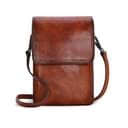
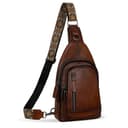
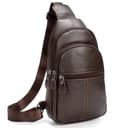
What Bellroy is genuinely better at
This section exists on every alternatives page we publish, and on this one it is the longest. If the things below are what you are buying, buy the original.
It names the grade and the tannery standard.Two claims, not one. “Full-grain” tells you which layer of the hide you are getting; a gold rating from the Leather Working Group is an audit of the tannery’senvironmental and traceability practice. The second claim is the rarer one — our full-grain explainer covers why the first is worth something, and our guide to vegetable versus chrome tanning covers what “chrome-tanned” actually means, because it is a description rather than a demerit: chrome tanning is what makes a supple, color-stable hide, and it is what most bag leather on earth is.
A six-year warranty on bags. Its warranty page states “Bags: 6-year warranty”(ten on luggage, three on wallets and accessories), excluding “expected wear and tear, expected signs of aging” and damage from “unreasonable use or neglect,” and requiring “verifiable proof of purchase.” Put that against our registry: three of the 90 bag listings we track state any warranty term at all, and the longest is two years. Six years is three times the best number in our whole dataset. Our page on what a leather bag warranty actually covers explains why the exclusions matter as much as the length — but a stated six-year term with a claims process is a different product from a marketplace listing with none.
Care advice with nothing to sell you.Its cleaning page tells you to keep leather “away from water,” that if it gets wet you should “not rub with a cloth or dry with a dryer,” to clean with “a clean, dry cloth” and specifically nota damp one “as the leather will absorb any excess moisture,” and to condition with “a good quality leather conditioner” — recommending a category rather than its own product. That is more conservative than most brand advice and it is correct. Our conditioning guide says the same thing at more length, and our wet-bag guide covers the dryer mistake specifically.
A real returns window. Thirty days from delivery for a full refund on a change of mind, with the bag in original condition and packaging, plus an extended holiday window on the date we read the page: purchases made between November 1 and December 31 2026 can be returned or exchanged until January 31 2027. You are buying from a company with a published process rather than from a listing.
The one thing that is genuinely a gap
Hide versus weave. It is not a quality argument and we are not going to pretend it is one — a well-made recycled-nylon sling will outlast a cheap leather one, shrug off rain that would mark hide, and weigh less doing it. The brand says as much about its own leather alternative: “Stronger, hardier and 25% lighter than leather.” On the measurable properties, that is probably true.
What a woven bag cannot do is change. A nylon sling looks the same on day one and day four hundred, and then it abrades, pills and frays, and it is finished. A full-grain hide bag starts stiffer and plainer and then absorbs handling into a finish nobody can manufacture — the thing our patina guide is about. If that is why you went looking, the material is the answer, not the brand. Our leather versus nylon comparison works the whole trade through and does not pick a side for you.
Two honest footnotes. First, the original does sell leather bags — its tote category page is titled for “Leather & Fabric,” so this is not a story about a brand avoiding hide. Second, we could not read a price or a model list from any of its collection pages, so no price for the original appears anywhere on this page, and no “save $X” claim is made. Our picks are cheaper, and the price difference is visible in the live figures on each card. That is as far as we will take a comparison we cannot source.
How we ranked the six
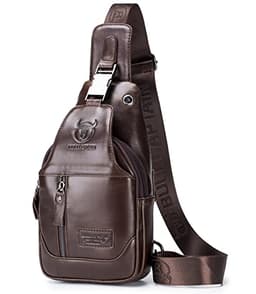
Published specifications first. On a page whose whole subject is disclosure, the bag that discloses wins. The BULLCAPTAIN publishes a dimension, a weight, a strap range and a tablet ceiling. None of the other five publishes a dimension or a weight.That is not a small gap — it means five of these six ask you to judge a sling’s size from a photograph of it on someone else’s shoulder.
Then the stated grade.The DONNAIN is the only full-grain pick here. The other five say “genuine leather” or “cowhide,” which names the animal but not the layer — see what “genuine leather” is allowed to mean. We print what each listing says and never round up.
Then what the bag admits it holds. A sling is defined by its ceiling. All six state a zip or zip compartments, which is better than the tote category manages; the useful differentiator is what fits beside the phone. The BULLCAPTAIN caps at a 7.9-inch iPad mini, the HESHE states a small tablet, and the Iswee is a single zip compartment with card slots and nothing more.
Then how it carries. A sling spends its life on one shoulder or across a chest, so the strap is the part that decides whether you keep the bag. Only the BULLCAPTAIN publishes a range. Our crossbody sizing guide has the measurements to take before you buy, and our shoulder pain guide explains why a 0.91 lb empty weight is a meaningful advantage on a single-strap bag.
Pick by what you were looking for
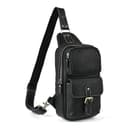
You wanted the sling shape in leather:the BULLCAPTAIN, and check its published 11.8 x 6.2 x 1.9 inches against your phone and wallet first. The Le’aokuu is the more rugged, outdoors-leaning version of the same idea in black.
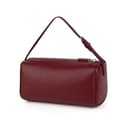
You wanted the best hide you can get in the shape:the DONNAIN, the only full-grain pick here. It is cut as a purse rather than a utility sling, which is worth knowing before you order, and the listing publishes no dimensions — so measure your must-carry items first.
You wanted the smallest possible everyday carry: the Iswee, a single zip compartment with card slots for a phone, cards and keys and genuinely nothing else. Our phone crossbody roundup is the page for that carry specifically, and it makes the case that this is the one size where hide costs no more than a coating.
You wanted to spend as little as possible: the molshine. It is the cheapest genuine-leather sling we track, it publishes nothing beyond its material, and at that price that is the deal.
You wanted a backpack or a tote, not a sling: this is the wrong page and we would rather say so. Our minimalist leather backpack roundup is the closest equivalent in that shape, and our lightweight leather tote page is the one that takes weight as seriously as a technical brand does.
You wanted the warranty and the company: buy the original. That is the honest end of this page. Nothing in our registry offers a six-year term, a claims process or a published returns policy, and no amount of price advantage changes that.
What none of these six gives you
Traceability.Not one listing in our registry names a tannery, a country of tanning, or any audited standard. “Full-grain” is the furthest any of them goes, and even that is a seller’s claim rather than a verified one — though it is a claim the FTC holds sellers to, which is why we record it.
Water resistance. None of the six states a finish or treatment. Leather and water are a managed relationship rather than a solved problem; our waterproofing guide is realistic about what a protector spray can and cannot do.
A weight you can plan around. One of six. On a single-strap bag worn for hours, that is the number we would most want and almost never get.
A grade-to-price relationship. Worth seeing in the live figures above: the full-grain pick here is not the dearest, and the dearest is not full-grain. Our men’s bags under $100 page counts that across the whole registry and finds sixteen full-grain bags below that ceiling — more than above it.